
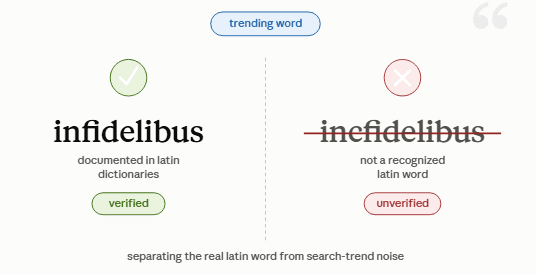
Incfidelibus is not a documented Latin word. No classical or ecclesiastical Latin dictionary lists it as an independent term. The word it closely resembles — and the one you’ll actually find in Latin references — is infidelibus, the dative or ablative plural of the adjective infidelis (“unfaithful,” “disloyal,” or “unbelieving”). Depending on context, infidelibus has historically meant something like “to the unfaithful” or “among the unbelievers.”
The current wave of online attention around “Incfidelibus” isn’t really about Latin at all. It’s the product of three separate things happening at once: an unusual spelling that spreads easily online, a cluster of SEO articles competing to “explain” it, and — more practically — reports of the word turning up as a sender name or subject line in scam emails. If you’re here because you got a strange email with this word in it, skip to The Scam-Email Connection and Should You Be Worried.
Table of Contents
- What Incfidelibus Actually Is — and Isn’t
- The Real Word Underneath: Infidelibus and Its Latin Grammar
- A Documented Historical Use: In Partibus Infidelium
- Where the Extra “C” Probably Came From
- Why This Obscure Word Is Suddenly Everywhere
- The Scam-Email Connection
- Incfidelibus vs. Infidelibus: A Direct Comparison
- Should You Be Worried If You’ve Seen This Word?
- Who Should Care About This — and Who Can Safely Ignore It
- Frequently Asked Questions
- Final Verdict
What Incfidelibus Actually Is — and Isn’t
Search “Incfidelibus” and you’ll find a striking pattern: dozens of nearly identical articles, most published within the last several weeks, all offering some version of the same vague description — that the word relates to “faith,” “loyalty,” “identity,” and “personal transformation.” Several go further, framing it as an ancient philosophical concept with roots in “classical Latin expressions.” Read closely, though, and almost none of these articles cite a primary Latin text, a historical document, or a dictionary entry that actually contains the spelling “incfidelibus.” That absence is itself informative.
It is not, based on the available evidence, any of the following:
- A documented classical or medieval Latin word.
- A known brand, app, or company name with any verifiable public presence.
- A recognized philosophical or literary term with an established scholarly history.
What it appears to be, based on converging reports across independent sources, is a spelling variant or transcription error of a genuine Latin word — one that picked up search traffic for reasons that have more to do with internet mechanics than linguistics.
The Real Word Underneath: Infidelibus and Its Latin Grammar
Strip the extra “c” out of “incfidelibus” and you get infidelibus, which is a real, well-documented Latin form. It comes from the adjective infidelis, built from the negating prefix in- plus fidelis (“faithful,” “loyal,” related to the noun fides, meaning faith or trust). Wiktionary’s Latin dictionary entry classifies infidelis as a third-declension, two-termination adjective meaning unfaithful, treacherous or disloyal, and — particularly in later Christian Latin — unbelieving or infidel.
Infidelis isn’t a rare or obscure coinage. Classical-era citations collected in the Latin Lexicon show the word used by Cicero and Caesar in ordinary political and rhetorical contexts, describing people or groups that couldn’t be relied upon or trusted — well before it took on the specifically religious “unbeliever” sense that later became dominant in medieval and ecclesiastical Latin, a shift also documented by Etymonline.
Grammatically, “-ibus” is a standard Latin plural ending for the dative and ablative cases of third-declension nouns and adjectives. That means infidelibus is simply infidelis declined into a specific grammatical slot — “to/for the unfaithful” (dative) or “by/with/from the unfaithful” (ablative), depending entirely on the sentence around it. This is a normal, everyday feature of Latin grammar, not evidence of any special or hidden meaning. A word ending in “-ibus” is about as mysterious, structurally, as an English word ending in “-s” for plural.
A Documented Historical Use: In Partibus Infidelium
If you want one genuinely verifiable historical example of infidelibus in real use, it’s the ecclesiastical Latin phrase “in partibus infidelium,” literally “in the parts/lands of the unbelievers.” Merriam-Webster defines it as a phrase historically attached to a bishop’s title when the diocese named had been lost to a non-Christian power — the bishop held the title without exercising authority over the actual territory.
According to the Catholic Encyclopedia, the practice of naming bishops to such “titular” sees became more formalized from the 16th century onward, as the Church preserved the memory of dioceses that had fallen outside Christian control, and the specific phrase “in partibus infidelium” was officially discontinued by a Vatican circular in 1882 in favor of alternative titular naming conventions — though the underlying practice of titular sees, described on Wikipedia, continues in modified form today.
This is worth including because it’s the opposite of what most “Incfidelibus” content offers: a specific, checkable historical fact, with named sources, rather than an atmospheric gesture toward “ancient wisdom.” It’s also the clearest illustration of what infidelibus actually meant in real documents — administrative and ecclesiastical, not mystical.
Where the Extra “C” Probably Came From
Nobody can point to a definitive, single origin moment for “incfidelibus” — and any article claiming certainty here is overstating what’s actually known. But a few explanations show up consistently across independent sources, and they’re plausible without requiring anything unusual:
- Simple mistyping. An extra letter dropped into an unfamiliar foreign word is a common and unremarkable error, especially with a word most people have never seen or heard spoken.
- OCR and transcription artifacts. Digitized historical texts and handwritten documents can introduce character errors when scanned or transcribed, occasionally producing spellings that never existed in the original.
- Search-engine reinforcement. Once a misspelling appears on even a handful of indexed pages, search engines can surface it for related queries, which encourages more content creators to write about “incfidelibus” specifically rather than correcting to infidelibus — a self-reinforcing loop rather than evidence of a separate word.
- Content-farm replication. Once a few sites publish “explainer” articles built around a specific spelling, competing sites tend to target the exact same spelling to capture the same search traffic, rather than the technically correct one.
That last point is visible in the current search results for this term: one of the pages actively publishing content about “incfidelibus” is hosted at a domain built around that exact spelling. That’s a small but concrete data point about how quickly a typo can generate its own dedicated web presence once search interest appears — the misspelling isn’t just being reported on, it’s being actively cultivated as a content niche.
Why This Obscure Word Is Suddenly Everywhere
Three separate dynamics appear to be driving current interest, and they’re worth separating clearly because they call for different reactions.
1. A wave of SEO “explainer” content. A cluster of near-identical articles — many published within roughly the same recent window — offer vague, philosophically-toned descriptions of “incfidelibus” without citing verifiable sources. This is a recognizable pattern: an unfamiliar, Latin-sounding word generates search curiosity, and content sites compete to rank for it with articles that sound authoritative while actually saying very little that can be checked. Several of the more careful sources in this space explicitly acknowledge this dynamic and push back on it, noting that the term lacks solid documented grounding as an independent word.
2. Genuine curiosity about digitized historical texts. As more archival and historical documents become searchable online, unfamiliar Latin-derived words do occasionally surface and spark legitimate interest
3. Scam emails. This is the part with the most practical stakes for readers, and it’s covered in detail below.
The Scam-Email Connection
Multiple independent sources report that “Incfidelibus” has appeared as a sender name or subject line in unsolicited extortion-style emails — the kind of message, sometimes called “sextortion” scams, that falsely claims to have compromised a victim’s webcam, device, or personal accounts and demands payment, typically in cryptocurrency, to prevent the release of supposedly compromising material.
This fits a well-documented and much older scam template that has nothing specifically to do with this word. According to Barracuda Networks, these emails frequently open with an old, breached password to create a false sense of credibility, then claim ongoing access to the victim’s device or contacts. Malwarebytes documented an active wave of this exact pattern as recently as March 2026, describing scammers who reuse old, breached passwords to make threatening messages appear credible.
A smaller number of sources describe a related but distinct pattern: the name appearing in connection with “hire a hacker” style offers — messages promising services like recovering lost cryptocurrency or altering academic records in exchange for an upfront fee, refusing conventional, traceable payment methods. This variant is corroborated by fewer independent sources than the sextortion pattern, so it should be treated as a less firmly established claim, though it fits the same broader category: an official-sounding name used to lend false credibility to an advance-fee or extortion scam. Neither pattern should be understood as evidence that “Incfidelibus” is a real hacking group, service, or organization — no source in this research turned up independent verification of an actual entity operating under that name.
Incfidelibus vs. Infidelibus: A Direct Comparison
| Incfidelibus | Infidelibus | |
|---|---|---|
| Listed in standard Latin dictionaries | No | Yes |
| Grammatical basis | None established | Dative/ablative plural of infidelis |
| Documented historical use | None found | Yes — e.g., in partibus infidelium |
| Most likely explanation | Misspelling / transcription variant | Genuine Latin word form |
| Common online context (2026) | SEO “mystery word” content, scam emails | Historical, religious, and academic Latin texts |
| Should you treat search results about it as reliable? | Treat with caution — verify against a dictionary source | Yes, when sourced from an actual Latin dictionary |
Should You Be Worried If You’ve Seen This Word?
It depends entirely on where you saw it.
- In an article, forum post, or social media caption trying to explain its “hidden meaning” — no cause for concern. You’re looking at speculative or recycled SEO content built around a misspelling, not evidence of anything real.
- As a sender name, in a subject line, or in the body of an unsolicited email — treat it exactly as you would any other unsolicited extortion or phishing attempt: don’t click any links, don’t reply, don’t pay, and don’t engage with the sender to “prove” the claim is false. Report the message as spam or phishing through your email provider. If the email includes a real password of yours pulled from an old data breach, that password is compromised — change it, along with the same password anywhere else you may have reused it — but its presence in the email does not mean the rest of the message’s claims are true.
- In a Latin text, academic source, or historical document — this is the one context where the underlying grammar is genuinely worth understanding. Where checking a real Latin dictionary against the spelling you encountered is the right move, since transcription differences do occasionally occur in older or scanned texts.
Who Should Care About This — and Who Can Safely Ignore It
Worth reading closely if you:
- Received an email, DM, or message containing this word and want to know whether to worry.
- Are researching Latin etymology or medieval/ecclesiastical terminology and want an accurate account rather than a vague one.
- Write or edit content and want to avoid repeating an unverified claim as fact.
Can safely skip the deep dive if you:
- Simply saw the word trending and were mildly curious — the short version above answers the question completely.
- Already know it’s a misspelling of infidelibus and just wanted confirmation.
FAQs
Is “Incfidelibus” a real Latin word? Not as an independently documented one. Standard Latin dictionaries and lexicons recognize infidelibus, not “incfidelibus.” The extra “c” isn’t supported by any historical Latin source found in this research.
What does “infidelibus” actually mean? It’s the dative or ablative plural form of infidelis (“unfaithful,” “disloyal,” or “unbelieving”). The exact English translation — “to the unfaithful,” “among the unbelievers,” and similar — depends on the sentence it appears in.
Why do so many websites have near-identical articles about this word? Because it generates search curiosity without a clear, established answer readily available, which creates an opening for content sites to compete for the same traffic — often repeating the same unverified framing rather than checking a primary Latin source.
Is Incfidelibus a company, app, or hacking group? No independent evidence of a legitimate company, app, or organized group operating under that name turned up in this research. Any email or message implying otherwise should be treated with skepticism.
I got an email with “Incfidelibus” in the subject line. Is my device actually hacked? Almost certainly not. This pattern matches long-running, mass-distributed extortion scam emails that make false claims about compromised devices or webcam access to pressure victims into paying. Don’t pay, don’t reply, and report the message as phishing.
Does “incfidelibus” have anything to do with romantic infidelity? Only by loose association through the shared Latin root fidelis (faithful). The word infidelis did carry a general sense of “unfaithful” beyond religious contexts in some classical usage, but there’s no documented evidence tying “incfidelibus” specifically to a romantic-infidelity concept.
External Sources
- Wiktionary — infidelis
- Wiktionary — in partibus infidelium
- Etymonline — infidel
- The Latin Lexicon — infidelis
- Latin Is Simple — infidelis declension
- Merriam-Webster — in partibus infidelium
- Catholic Answers Encyclopedia — In Partibus Infidelium
- Wikipedia — Titular See
- Barracuda Networks — What Is Sextortion?
- Malwarebytes — Sextortion “I recorded you” emails (March 2026)
- University of Michigan Safe Computing — Sextortion Scams
Author Bio
Written by the TrendCritique Research Desk. TrendCritique’s research team investigates trending online terms, viral claims, and digital-safety topics, cross-checking claims against primary sources — dictionaries, historical records, and established cybersecurity organizations — before publication, and clearly distinguishing verified information from unverified or speculative claims circulating elsewhere online.