
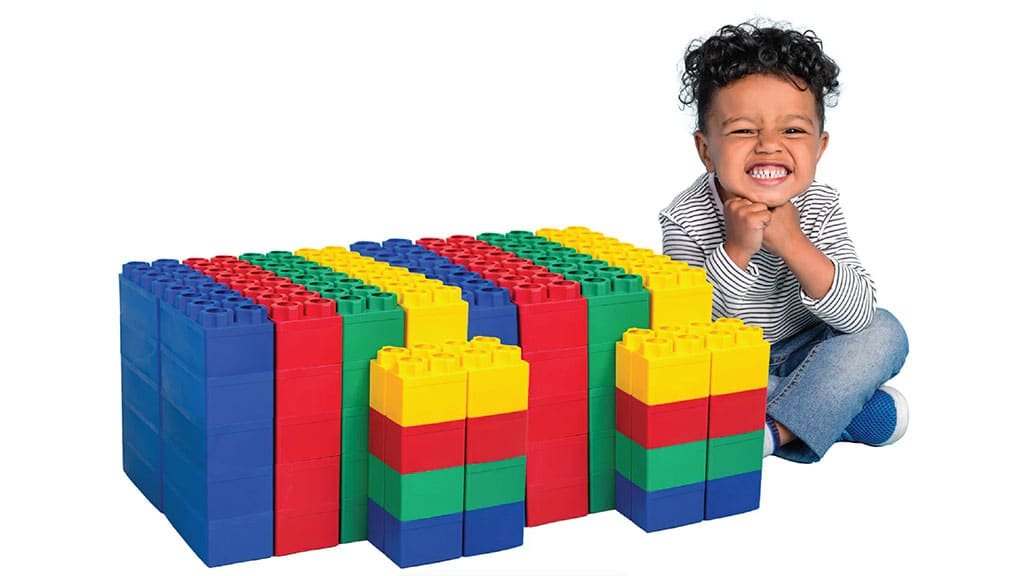
BiggoBlocks Jumbo Building Blocks are designed for a very different kind of construction play from conventional small building bricks. Instead of building something that fits on a table, children can use the oversized plastic blocks to create walls, forts, vehicles, towers, playhouses, and other large structures.
That difference is the main reason to consider them — and also the main reason they can become an expensive purchase.
BiggoBlocks currently sells sets ranging from a 24-piece beginner set to much larger 192-piece and 300-plus-piece sets. The company describes its blocks as being made from polypropylene, produced in Omaha, Nebraska, and suitable for indoor and outdoor play. It also states that its products are non-toxic, BPA-free, phthalate-free, and compliant with applicable CPSC and ASTM requirements.
The more important question, however, is not simply whether the blocks are good. It is whether you need large-scale construction play badly enough to justify the price and storage requirements.
Based on current product information and customer feedback, Biggo Blocks make the most sense for children who enjoy open-ended building and for families, classrooms, or groups that can benefit from having enough pieces to build substantial structures. A small set can work as an introduction, but buyers interested in forts and larger constructions should expect to need considerably more pieces.
Are Biggo Blocks Worth Buying?
Yes, for the right type of builder — but the set size matters enormously.
Biggo Blocks have several clear advantages:
- Oversized pieces make large-scale construction possible.
- The plastic construction is more suited to active play than many cardboard alternatives.
- The blocks are marketed for both indoor and outdoor use.
- Multiple Biggo sets can be combined.
- The company offers small starter sets as well as very large collections.
- Customer feedback generally describes the blocks as engaging and sturdy.
The biggest drawbacks are equally important:
- The larger sets are expensive.
- A small set may feel inadequate for ambitious builds.
- Storage is an issue, and some customers specifically wished sets included storage.
- Customer feedback includes complaints about blocks being smaller than expected or structures not holding together well enough to move.
- Product pages and retailer listings are not always perfectly consistent about recommended ages and current pricing.
So this is not a product where buying the cheapest set automatically gives the best value.
If the goal is simply stacking and basic construction, cheaper alternatives may be sufficient. If the goal is building large structures that children can interact with, Biggo Blocks become much more compelling.
What Are Biggo Blocks?
Biggo Blocks are large, interlocking plastic construction blocks intended for children to build oversized structures.
The concept sits somewhere between conventional building bricks and large play equipment. Instead of making small models, the scale of the pieces allows children to build things that occupy a meaningful part of a room or play area.
BiggoBlocks says its blocks have been made in Omaha, Nebraska, since 2008. The company also describes them as being made from premium polypropylene and promotes them for indoor and outdoor use.
The current product range includes:
- 24-piece beginner sets
- 48-piece learner sets
- 92-piece large-block sets
- 96-piece standard sets
- 192-piece jumbo sets
- 288-, 336-, and 432-piece Mega Sets
- A 624-piece Educator Set
- Sets containing wheel kits for vehicle-style builds
That range is important because “Biggo Blocks” is not really one product. It is a construction system with different quantities and accessories.
Biggo Blocks Sizes and Prices
Prices can change, so the figures below reflect the BiggoBlocks website information checked on August 26, 2026 rather than a permanent MSRP.
| Set | Current listed price | Best suited to |
|---|---|---|
| 24-piece Beginner Set | $52.99 | Trying the concept / smaller builds |
| 48-piece Learner Set | $94.99 | More flexible individual play |
| 92-piece Large Block Set | $155.99 | Builders who prefer large pieces |
| 96-piece Standard Set | $179.99 | Larger home builds |
| 192-piece Jumbo Set | $332.99 | Forts, larger structures, group play |
| 336-piece Mega Set | $569.99 | Large groups / very large builds |
| 624-piece Educator Set | $999.99 | Classrooms and educational settings |
These are the prices currently displayed by BiggoBlocks and can change. The company’s store also lists additional 288- and 432-piece Mega Sets.

The price-per-piece problem
At first glance, the larger sets look expensive. But the more useful question is how many pieces a child actually needs for the intended type of play.
A 24-piece set is inexpensive compared with a 192-piece set, but it also provides far fewer possibilities for large structures.
This is one of the most important purchasing considerations that appears repeatedly in customer feedback: buyers who want forts, houses, walls, or other substantial structures often end up wanting additional sets.
One customer reviewing the 192-piece set said that two 96-piece sets were enough for a four-wall playhouse without a roof, with pieces remaining for small furnishings. That is customer experience rather than a manufacturer specification, so it should be treated as an example rather than a guaranteed build capacity.
What You Actually Get With Biggo Blocks
The construction system uses different block sizes rather than giving you one uniform brick.
For example, the 192-piece set listed by BiggoBlocks contains:
- 40 large red blocks
- 40 large yellow blocks
- 40 large blue blocks
- 40 large green blocks
- 8 half red blocks
- 8 half yellow blocks
- 8 half blue blocks
- 8 half green blocks
The company lists the material as premium polypropylene.
The 48-piece single-color sets similarly contain 40 large pieces and eight smaller pieces. BiggoBlocks lists the product dimensions for those sets at 16 × 31 × 16.5 inches and a weight of 16 pounds.
That mixture of sizes is useful because large pieces make construction quick while smaller pieces can provide more flexibility.
How Biggo Blocks Differ From Regular Building Bricks
The biggest difference is scale.
Traditional construction toys are primarily designed for detailed models. Biggo Blocks are designed around physical construction.
That changes the kind of play possible.
A child using small bricks might spend a long time constructing a detailed vehicle. With Biggo Blocks, the same child can instead build something large enough to sit behind, walk around, or incorporate into pretend play.
This makes the product particularly interesting for:
- Fort building
- Pretend houses
- Castles
- Large walls
- Vehicle-inspired constructions
- Group building
- Classroom construction activities
- Open-ended imaginative play
BiggoBlocks also sells wheel kits that allow children to turn blocks into moving constructions. Its five-car-kit set includes five large blocks, one half block, and five wheel sets.
The trade-off is detail. If a child primarily enjoys miniature construction, conventional building systems may offer more precision for considerably less space.
Build Quality: What Does the Evidence Suggest?
BiggoBlocks says its products use premium polypropylene and describes the blocks as durable. The company also says they are designed for indoor and outdoor use and can be wiped clean.
Customer feedback generally supports the idea that the blocks are sturdy enough for active construction play, but it is not completely uniform.
For example, Walmart reviews include customers praising the blocks’ quality and sturdiness, while another reviewer complained that the pieces did not hold together well enough to move an assembled wall without it falling apart.
Other independent customer feedback has mentioned occasional warping and pieces that were somewhat smaller than expected.
This is an important distinction.
“Sturdy enough to build with” does not necessarily mean “a rigid structure that can be safely picked up and moved.”
Parents should therefore think of these primarily as construction pieces rather than permanently connected structural components.
Are Biggo Blocks Safe?
BiggoBlocks states that its products are:
- Non-toxic
- BPA-free
- Phthalate-free
- CPSC compliant
- ASTM compliant
The company also says its products have passed applicable safety assessments.
That is useful information, but it should not be interpreted as a blanket statement that every possible use of a large structure is safe.
Parents should still follow the manufacturer’s age and use guidance and supervise children appropriately, particularly when children are building structures large enough to climb into or around.
There is also an important inconsistency worth mentioning: BiggoBlocks’ product marketing commonly describes the blocks as being suitable for ages 4–8 while also referring to toddlers ages 3+. Retail listings likewise show different age descriptions.
For a purchase involving a younger child, the safest approach is to check the age guidance on the exact set being purchased rather than assuming every Biggo product has identical recommendations.
Are Biggo Blocks Good for Toddlers?
They can be appropriate for younger children according to the manufacturer’s current product information, but this is where parents should pay attention to the exact product and intended activity.
The advantage for young builders is obvious: large pieces are easier to see, grip, stack, and incorporate into large constructions than tiny bricks.
However, large structures introduce a different consideration. A child who is old enough to manipulate a block may not necessarily be old enough to understand how an unstable wall or tower can behave.
So the most sensible use for younger children is supervised, open-ended construction on a stable surface, rather than assuming that any structure shown in promotional imagery is appropriate for independent climbing or physical play.
What Customers Like About Biggo Blocks
Across retailer and manufacturer-hosted reviews, several themes appear repeatedly.
1. Children can build something genuinely large
This is the defining benefit.
Customers frequently describe children building forts, walls, houses, vehicles, and other structures. That is exactly the experience the product is designed around.
2. The blocks encourage open-ended play
There is no single finished model that children have to reproduce.
That can make the toy useful for children who enjoy inventing their own constructions rather than following instructions.
3. Multiple children can participate
Large construction projects naturally lend themselves to group play.
The company’s larger sets are explicitly marketed toward classrooms, parties, families, and other group environments.
4. The blocks are easier to keep track of than tiny bricks
Some customer feedback specifically mentions appreciating the larger pieces because they are easier to spot and less likely to disappear into the household than small blocks.
The Biggest Problems With Biggo Blocks
The price is high
This is the most obvious weakness.
The current official price for the 96-piece standard set is $179.99, while the 192-piece set is $332.99. Larger sets can exceed $500 or even $1,000.
That is a significant investment for a children’s construction toy.
A small set may not be enough
This is arguably more important than the sticker price.
A 24-piece set can introduce children to the system, but it is unlikely to deliver the same large-scale building possibilities shown in promotional examples.
Customer feedback repeatedly points toward the same practical issue: people often want more pieces once they start building larger structures.
Storage needs more thought than you might expect
Biggo Blocks take up substantially more physical space than conventional building bricks.
The company itself recommends storing them in bins and offers several space-saving approaches, including building a temporary wall for storage.
Some customers have specifically criticized the absence of included storage.
If your home already struggles with toy storage, this should be considered before buying a large set.
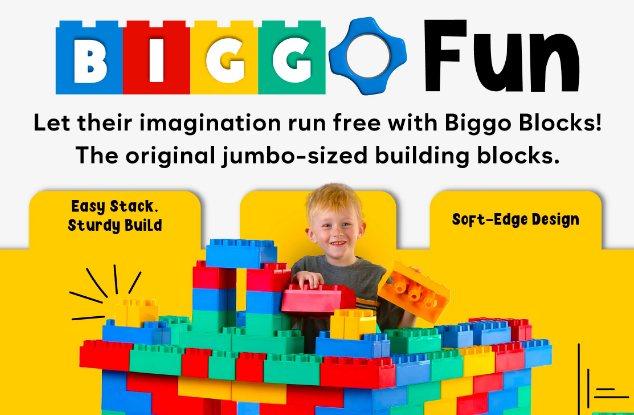
Biggo Blocks vs. Cardboard Jumbo Blocks
One of the most relevant alternatives is the Melissa & Doug Jumbo Extra-Thick Cardboard Building Blocks.
Current retail listings show the Melissa & Doug set at a substantially lower price than comparable Biggo sets. It uses extra-thick cardboard and comes in different sizes, making it suitable for large-scale construction without the same plastic construction system.
The trade-off is straightforward:
| Consideration | Biggo Blocks | Jumbo Cardboard Blocks |
|---|---|---|
| Material | Plastic | Cardboard |
| Large-scale construction | Excellent fit | Good fit |
| Outdoor suitability | Designed for indoor/outdoor use | More limited |
| Durability for active play | Stronger fit | More vulnerable to wear |
| Storage | Can take considerable space | Usually easier to collapse/store |
| Price | Relatively high | Generally lower |
| Construction style | Interlocking blocks | Stacking/building |
| Best for | Active, reusable construction | Affordable large-scale play |
If you want a reusable plastic building system that can be used indoors and outdoors, Biggo has the stronger proposition.
If you want inexpensive oversized building pieces for occasional indoor play, cardboard may make more financial sense.
Which Biggo Blocks Set Should You Buy?
Best for trying Biggo: 24-piece Beginner Set
At the current listed price of $52.99, this is the logical entry point for someone who is unsure whether their child will enjoy the concept.
The limitation is obvious: there simply are not many pieces.
Choose it when you want to test the idea rather than create a large fort immediately.
Best middle ground: 96-piece Standard Set
The 96-piece set is listed at $179.99 and is positioned by BiggoBlocks as one of its core sets.
For a household that expects regular building play, this is a more practical starting point than buying multiple small sets.
Best for serious building: 192-piece Jumbo Set
At $332.99 currently, the 192-piece set is expensive, but it crosses an important threshold: there are enough pieces for substantially more ambitious construction.
If the goal is forts, houses, larger walls, and group projects, this is much closer to the kind of use case for which Biggo Blocks justify their premium.
Best for classrooms and groups: Mega or Educator sets
BiggoBlocks currently lists sets of 288, 336, 432, and 624 pieces.
These make more sense for classrooms, daycare environments, events, or other settings where many children can use the blocks together.
For an average household, spending close to $1,000 on the 624-piece Educator Set is difficult to justify unless the blocks are going to receive unusually heavy use.
Who Should Buy Biggo Blocks?
Biggo Blocks are a strong candidate if:
- Your child enjoys building forts and structures.
- You want a screen-free, open-ended construction activity.
- Multiple children will play together.
- You have enough floor and storage space.
- Indoor/outdoor flexibility matters.
- You are willing to buy enough pieces for the intended construction scale.
- You want a reusable plastic system rather than cardboard.
They are less compelling if:
- Your child prefers detailed miniature models.
- You have very limited storage space.
- You only need occasional building activities.
- Your budget is tight.
- You expect a small set to produce large fort-sized structures.
- You specifically want included storage.
Biggo Blocks: Pros and Cons
Pros
- Large-scale construction is the core strength.
- Plastic construction is well suited to repeated active play.
- Designed for indoor and outdoor use.
- Multiple set sizes make the system expandable.
- Wheel kits add another type of construction play.
- The manufacturer states that the products meet applicable CPSC and ASTM requirements.
- Customer feedback is generally positive about children’s engagement and the blocks’ usefulness for large builds.
Cons
- Larger sets are expensive.
- Small sets can feel limiting for ambitious projects.
- Storage is not built into the standard sets.
- Some customers report connection or size-related frustrations.
- Current product pages and retailers do not always present identical age or pricing information.
- Large structures require more floor space than conventional construction toys.
Biggo Blocks FAQs
Are Biggo Blocks worth the money?
They can be, particularly for children who regularly enjoy large-scale construction. The value becomes harder to justify if the blocks will only be used occasionally or if a small set is expected to support large projects.
What age are Biggo Blocks for?
BiggoBlocks commonly markets its jumbo blocks toward children around ages 4–8 while also referring to use by children ages 3 and up. Exact guidance can vary by product, so check the age recommendation for the specific set you are buying.
Are Biggo Blocks made in the USA?
BiggoBlocks says its blocks are made in Omaha, Nebraska, and its contact page says the company has crafted them there since 2008.
Can Biggo Blocks be used outside?
Yes. BiggoBlocks markets its jumbo blocks for both indoor and outdoor use.
Do Biggo Blocks come with storage?
Standard sets do not appear to include a dedicated storage container. BiggoBlocks recommends using storage bins and also suggests storage methods involving the blocks themselves.
Can different Biggo Blocks sets be combined?
Yes. BiggoBlocks states that its sets are compatible with other Biggo Block sets, allowing collections to be expanded over time.
Do Biggo Blocks have a warranty?
BiggoBlocks currently offers a one-year limited warranty covering manufacturing defects in materials and workmanship. It does not cover normal wear, accidental damage, misuse, modifications, or purchases from unauthorized retailers.
What is the biggest mistake to avoid when buying Biggo Blocks?
Buying too few pieces for the type of construction your child wants to make. If the goal is a substantial fort or playhouse, look beyond the cheapest starter set and think about the number of pieces needed for that activity.
Final Verdict: Are Biggo Blocks a Good Buy?
Biggo Blocks are not trying to beat traditional building bricks at their own game. Their strength is scale.
They turn construction from a tabletop activity into something much more physical. A child can build a wall, make a fort, create a pretend vehicle, or collaborate with other children on a structure that occupies real space.
That makes the product genuinely different from ordinary construction toys.
The biggest concern is value. Biggo Blocks are expensive enough that the quantity you buy matters almost as much as the quality of the blocks themselves. A 24-piece set may be a sensible introduction, but families attracted by the large structures shown in product imagery should be realistic about how many pieces those projects require.
The customer evidence is broadly favorable, but not flawless. Buyers have reported strong enjoyment and good durability while others have mentioned insufficient quantities, storage concerns, connection problems, or expectations about size.
Our assessment is therefore straightforward:
Buy Biggo Blocks if your priority is large-scale, open-ended construction and you have the space and budget to buy enough pieces. Skip them if you mainly want inexpensive building blocks or detailed miniature construction.
For most households considering the system seriously, the 96-piece set is the more sensible starting point than the 24-piece set, while the 192-piece set makes more sense for families specifically interested in forts, larger structures, and group play.
The product’s strongest feature is not a particular material or marketing claim. It is the simple fact that children can build at a scale that changes what “building blocks” can mean.
External Sources
- BiggoBlocks official website — primary source for current product range, company claims, pricing, materials, and product information.
- BiggoBlocks warranty information — warranty terms and exclusions.
- BiggoBlocks shipping policy — current shipping information and geographic limitations.
- Target’s jumbo blocks category — useful for contextual comparison with other jumbo building-block options.
Editorial Research Note
This article was researched using current BiggoBlocks product and policy pages plus retailer/customer-review sources. Customer reviews are presented as evidence of reported experiences, not as TrendCritique testing results.
Quality-control audit completed: factual claims were checked against available sources; no personal testing, invented specifications, fabricated experiences, screenshots, statistics, experts, or sources were added. The article distinguishes manufacturer claims from customer feedback and editorial analysis, acknowledges product-information inconsistencies, avoids unsupported universal conclusions, and keeps the buying recommendation tied to the reader’s intended use.