
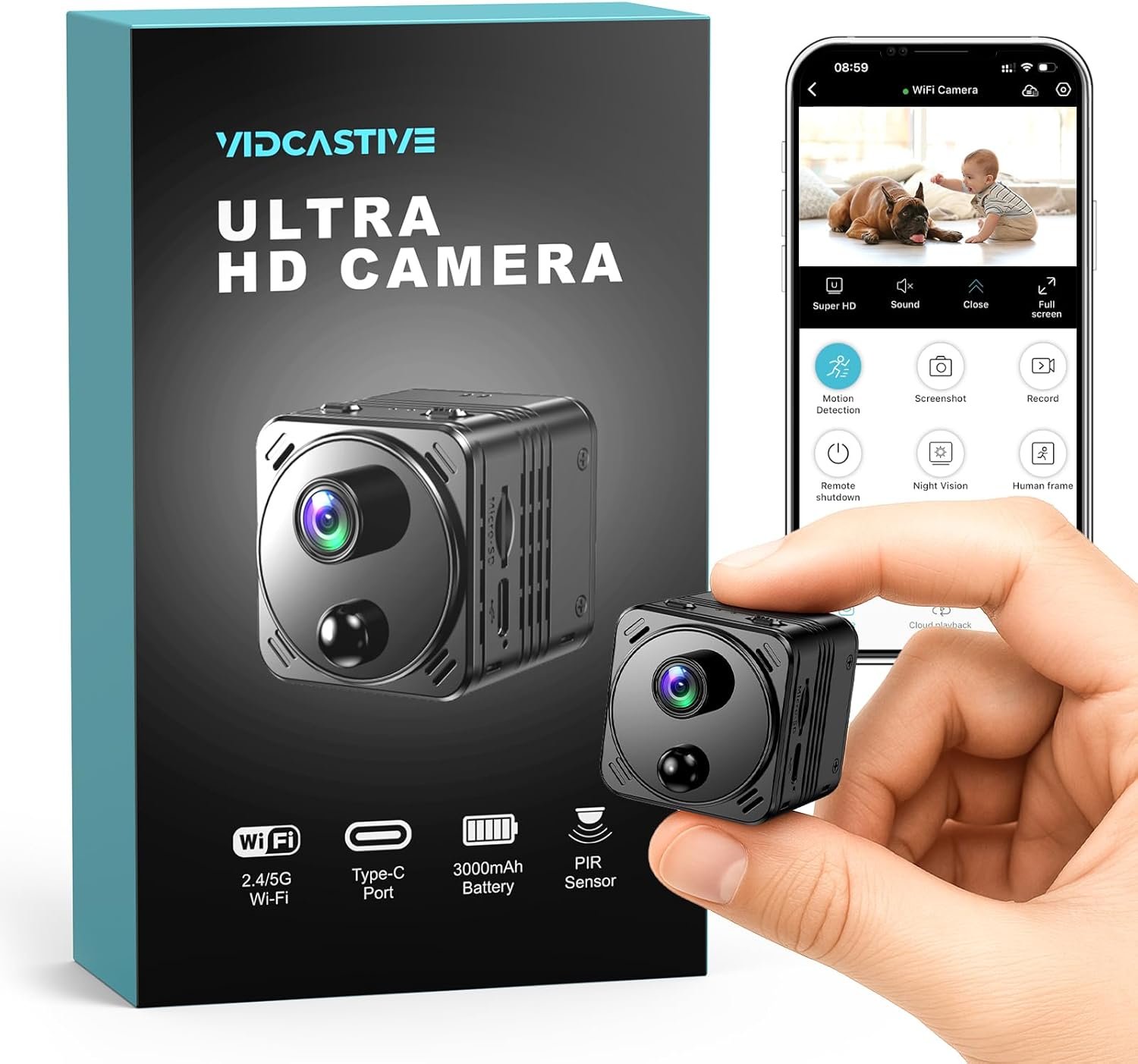
The vidcastive 4k mini spy camera – best all-around is a low-cost, battery-powered hidden camera sold through Vidcastive’s own Shopify store and Amazon, typically priced between $40 and $60 depending on the model. It’s marketed heavily around “4K” video and multi-day battery life. Based on Vidcastive’s own published technical specifications, the camera’s live view can be displayed at a 4K setting, but recorded footage saved to the SD card is Full HD 1080p — a detail that appears in the official spec sheet but not in the marketing copy above it. Battery life, Wi-Fi band support, and physical size also vary noticeably between the different products Vidcastive sells under nearly identical “4K Mini Spy Camera” names, so the exact listing you buy matters more than the brand name does.
Table of Contents
- What Exactly Is “The” Vidcastive 4K Mini Spy Camera?
- Vidcastive Model Comparison
- The 4K Question: What the Marketing Says vs. What Vidcastive’s Own Spec Sheet Says
- Battery Life: Advertised vs. Reported
- Motion Detection, AI Human Detection & Night Vision
- App, Wi-Fi, and Storage — The Fine Print
- Design and Concealment
- Who’s Actually Behind Vidcastive?
- Is It Legal to Use a Camera Like This?
- A Note on How This Product Is Reviewed Online
- Pros and Cons
- Who Should Buy It — and Who Shouldn’t
- Alternatives Worth Comparing
- FAQs
- Final Verdict
What Exactly Is “The” Vidcastive 4K Mini Spy Camera?
Here’s the first thing worth knowing before you compare prices: there isn’t one Vidcastive 4K Mini Spy Camera. There are several.
Vidcastive is a direct-to-consumer electronics brand selling through its own Shopify storefront (vidcastive.com) and through Amazon listings, and it uses the phrase “4K Mini Spy Camera” — or close variants like “4K Mini Wireless Camera,” “vidcastive 4k mini hidden camera,” and “vidcastive v30 4k mini wifi camera” — across at least four distinct hardware products found during research for this article:
- The R8 / V30, a cube-shaped camera (40 x 40 x 40mm) with a 3,000mAh battery
- The R10, a smaller, key-fob-shaped camera (1.73 x 1.73 x 1.1 in.) with a 1,500mAh battery
- A newer dual-band 2.4/5GHz listing on Amazon with a 3,000mAh battery and different marketing copy
- A separate 1080p wide-angle model sold without the “4K” claim at all
They share a family resemblance — magnetic mount, PIR motion sensor, AI human detection, night vision, companion app — but the battery capacity, recording time, physical dimensions, and price differ meaningfully between them. If you’re comparing this camera to a “Vidcastive review” you read somewhere else, there’s a real chance the reviewer tested a different physical product than the one currently in your Amazon cart. That’s worth checking before you buy: match the exact model number or product photo, not just the brand name.
Vidcastive Model Comparison
| Feature | R8 / V30 | R10 | Dual-Band (newer Amazon listing) |
|---|---|---|---|
| Advertised resolution | “4K Ultra HD” live | “4K” live | “4K” |
| Actual recorded resolution (per official spec sheet) | Full HD 1080p | Full HD 1080p | Not specified in available listing text |
| Battery capacity | 3,000mAh | 1,500mAh | 3,000mAh |
| Continuous recording time | ~15 hours | 5–6 hours | ~15 hours |
| Standby time (remote shutdown mode) | Up to 150 days | Up to 100 days | Up to 150 days |
| Wi-Fi bands | 2.4GHz / 5GHz | 2.4GHz only | 2.4GHz / 5GHz |
| Field of view | 150° | 150° | Not specified in available listing text |
| Physical size | 40 x 40 x 40mm | 1.73 x 1.73 x 1.1 in. | Not specified in available listing text |
| Free cloud storage | 3-day rolling cycle | 3-day rolling cycle | Not specified in available listing text |
| Listed price (official site) | $59.99 | $49.99 | Varies by Amazon listing |
Specifications sourced from Vidcastive’s own product pages and Amazon listings as of August 2026. Pricing and availability change frequently — verify current specs on the specific listing before purchasing.
The 4K Question: What the Marketing Says vs. What Vidcastive’s Own Spec Sheet Says
This is the single most useful thing to know before buying, and it’s easy to miss because it’s not hidden in a bad way — it’s just placed differently than the headline claim.
Both the R8/V30 and R10 product pages open with language like “Stunning 4K Ultra HD Live Video” and “Immersive 4K Clarity.” Scroll further down to the “Technical Details” table on the same pages, and the video resolution row reads, verbatim on both listings:
“Live view in 4K/1080P/640P optional, record in REAL Full HD 1080P”
In plain terms: you can view the live stream at a 4K display setting in the app, but the video that actually gets saved — to the microSD card or to cloud storage — is recorded at 1080p, not 4K. Vidcastive isn’t unique in doing this; it’s a common practice across the budget hidden-camera category, where “4K” often describes an interpolated or upscaled display option rather than the native resolution captured by the sensor and written to file. Industry guides on camera resolution consistently warn buyers to check whether a “4K” spec refers to true captured detail or to display/streaming resolution, precisely because the two get conflated in product marketing.
What this means practically: if you’re buying this camera expecting 4K evidentiary detail — reading a face clearly from across a room, for example — you should plan around 1080p performance, not 4K. Full HD 1080p is genuinely serviceable for most home-monitoring use cases (identifying a person, general activity, close-range detail), but it is not the same capability the word “4K” implies, and several third-party review sites that call this camera’s video “sharp 4K resolution” appear to be repeating the marketing headline rather than the manufacturer’s own spec table.
Battery Life: Advertised vs. Reported
Vidcastive advertises battery performance in three separate numbers, and it’s worth understanding what each one actually measures:
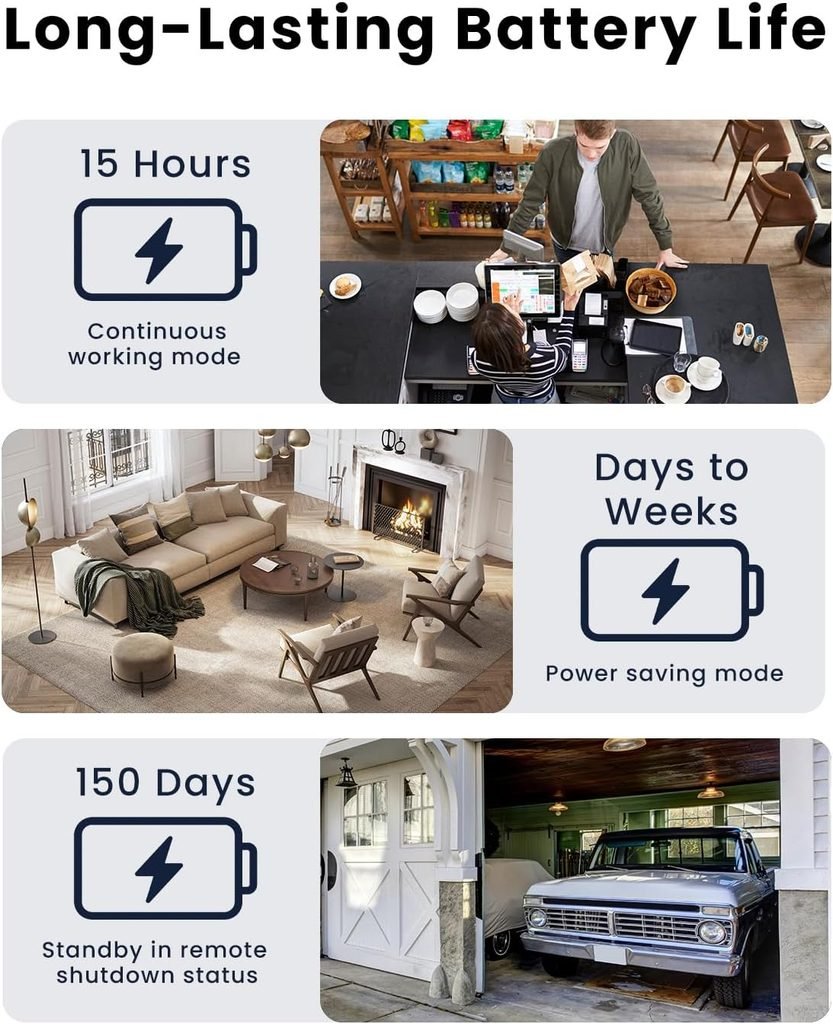
- Continuous recording time (5–6 hours on the R10; ~15 hours on the R8/V30/dual-band): this is how long the camera can record non-stop on a single charge.
- Power-saving / motion-triggered mode (roughly 7–20 days): the camera stays mostly dormant and only wakes to record when its PIR sensor detects motion, which stretches battery life dramatically but depends entirely on how much motion it actually sees.
- Remote shutdown standby (100–150 days): the camera is fully powered down and can be woken through the app — useful for storage, not for active monitoring.
Independent commentary found during research is mixed but points in a consistent direction: some reviewers report satisfactory runtime in line with the advertised figures, while a recurring complaint in critical, lower-starred reviews involves shorter-than-expected battery life — cameras going dead well before the advertised window, particularly in motion-triggered use rather than continuous plugged-in recording. This gap is common across the budget hidden-camera category generally, because “battery life” claims are usually best-case numbers measured under low-trigger conditions, and real-world performance depends heavily on how often the camera is actually recording, ambient temperature, and Wi-Fi signal strength (a weak connection makes the radio work harder and drains the battery faster).
Practical takeaway: if you need genuinely unattended, long-duration monitoring without daily charging, don’t rely on the headline battery number. Budget for either frequent recharging, a model that supports recording while plugged in (both the R8 and R10 do), or a different product category — a plug-in camera — for locations where concealment isn’t required and constant power is available.
Motion Detection, AI Human Detection & Night Vision
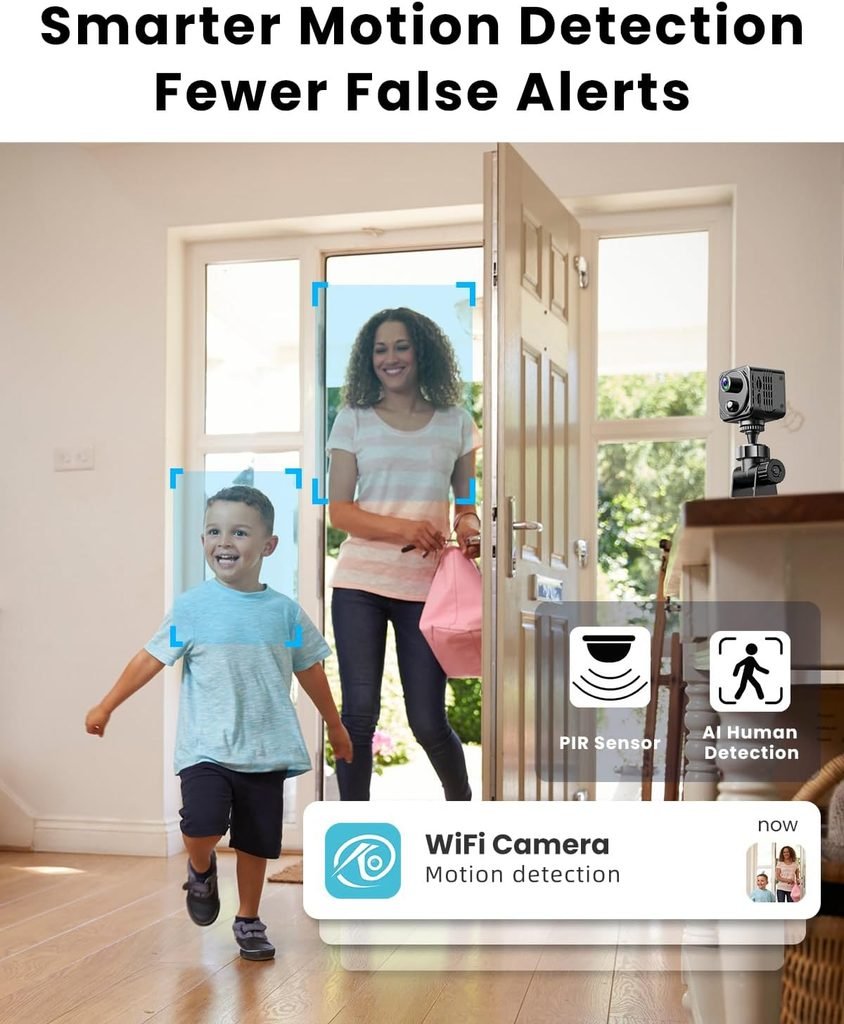
Vidcastive’s cameras use a PIR (passive infrared) motion sensor combined with on-device “AI human detection,” which is designed to distinguish a person from a pet, a ceiling fan, or a passing car headlight, and to only send a push alert when a human is detected. This is a standard feature across most modern Wi-Fi cameras at this price point, not something unique to Vidcastive, and on-device human detection at this price tier is generally less accurate than the cloud-based AI detection used by more expensive mainstream security brands — expect it to meaningfully cut down false alerts compared with basic motion sensing, but not to be perfect.
Night vision is infrared-based with a claimed range of about 26 feet, and — like most IR night vision — footage in the dark is recorded in black and white rather than color, since color night vision (a feature some competing brands now offer via a built-in spotlight) requires visible light rather than infrared.
App, Wi-Fi, and Storage — The Fine Print
A few details from the spec sheets are easy to gloss over but affect day-to-day usability:
- Wi-Fi band support varies by model. The R10 only works on 2.4GHz networks; the R8/V30 and the newer dual-band listing support both 2.4GHz and 5GHz. If your home router uses a combined or 5GHz-only network name, confirm compatibility with the specific listing before buying, since connecting an R10 to a 5GHz-only network simply won’t work.
- Free cloud storage is limited to a rolling 3-day cycle. Motion-triggered clips are stored in the cloud, but older clips are overwritten after three days unless you pay for a longer-retention plan or use a local microSD card (up to 256GB, not included) for extended storage.
- The camera can work without Wi-Fi, recording locally to an SD card, but Vidcastive’s own materials note this isn’t the recommended way to use it, since you lose remote viewing and push alerts.
- Setup is app-based (iOS/Android) and Vidcastive advertises a roughly three-minute pairing process, consistent with most Wi-Fi camera setups in this category.
Design and Concealment
The R10’s key-fob-like shape and small footprint are genuinely compact, and the magnetic backing plate lets you stick it to metal surfaces without drilling or adhesive. The R8/V30’s cube shape is slightly larger but still small enough to tuck onto a shelf or in the gap between books. Both are more “small camera” than “camera disguised as an unrelated object” — they don’t hide inside a clock, an alarm clock, or a USB charger the way some dedicated covert cameras do. If true disguise (not just small size) is the priority, this product line isn’t built for that; it’s designed to be inconspicuous through size rather than through mimicry of another object.
Who’s Actually Behind Vidcastive 4k mini hidden camera?
Vidcastive’s own “About” page describes itself as a long-time “offline supplier of security and surveillance solutions” that built a “factory-to-consumer” online brand, but it does not list a company registration, physical business address, or executive team on the pages checked for this review. The listed contact point is a Gmail address rather than a company-domain email, which is common among smaller direct-to-consumer Shopify brands but is a lower level of transparency than you’d get from an established security brand with a dedicated support line, live chat, or listed corporate address.
It’s also worth noting that near-identical hidden cameras — same magnetic mount, same PIR sensor, same general form factor — are sold on Amazon under other brand names (for example, listings from brands like realhide, AOBOCAM, and Shibet appear alongside Vidcastive’s own listings with comparable specs). This is typical of the budget hidden-camera market broadly: many of these products originate from the same pool of Chinese OEM/ODM hardware manufacturers and are rebranded by different sellers, rather than being engineered independently by each brand. That’s not automatically a red flag — it’s simply how this category works — but it does mean brand loyalty carries less weight here than it might with a camera built and supported by a single vertically integrated company.
No independent scam reports, lawsuits, or BBB complaints specific to Vidcastive turned up during research for this article. That absence isn’t proof of a clean track record — it may simply reflect a small company with limited review volume — so treat it as “nothing found” rather than “verified clean.”
Is It Legal to Use a Camera Like This?
Because this product is explicitly marketed with words like “spy” and “covert,” it’s worth being direct about the legal landscape, which applies regardless of which brand of hidden camera you use.
- Recording video only, in a space you own or control, is generally legal in the U.S. — a driveway, a front porch, a living room in your own home.
- Recording audio is a separate and stricter legal question. Under federal law and most state laws, audio recording of a conversation generally requires the consent of at least one party to that conversation; roughly a dozen U.S. states require all parties to consent, and violating this can carry criminal penalties, not just civil ones. If your camera captures audio, this matters even if you’re the property owner.
- Recording in places where someone has a reasonable expectation of privacy — bathrooms, bedrooms used by guests, changing areas — is illegal in all 50 states, regardless of consent laws, and can fall under video voyeurism statutes with serious criminal consequences.
- Recording someone without their knowledge in your own home is not automatically legal just because you own the property. In two-party consent states in particular, secretly recording a spouse, roommate, or guest’s private conversation can still violate wiretapping law.
- Laws vary by state and by country, and this article isn’t legal advice — if you’re planning to use a hidden camera in any situation involving another adult’s private space or conversations, it’s worth checking your specific state’s consent laws or speaking with an attorney first.
How This Product Is Reviewed Online
Worth flagging for anyone comparison-shopping: several “Vidcastive review” articles found during research for this piece use strikingly similar structure, phrasing, and conclusions — including two articles published on the same date that both open with a near-identical framing device, repeat the same “sharp 4K resolution” claim found in Vidcastive’s marketing copy, and describe testing in general terms without documenting specific methodology (test conditions, footage samples, comparison benchmarks). That pattern is common across affiliate-driven “best of” content generally, and it’s a useful reminder to weigh any single glowing review — including roundup articles that crown vidcastive v30 4k mini wifi camera a “top pick” — against the manufacturer’s own published specifications rather than against marketing language repeated across multiple sites. It doesn’t necessarily mean those reviews are dishonest, but independent, verifiable testing details (not just a star rating) are what separate a useful review from a rewritten product description.
Pros and Cons
Pros
- Genuinely compact and easy to place discreetly via the magnetic mount
- AI human detection reduces false motion alerts compared with basic PIR-only cameras
- Multiple battery modes (continuous, power-saving, remote standby) offer real flexibility
- Works fully offline with local SD storage if you don’t want cloud/Wi-Fi dependency
- Competitively priced against other battery-powered hidden cameras in the same tier
- Supports recording while charging, useful for semi-permanent placements
Cons
- Recorded footage is 1080p, not 4K, despite prominent “4K” marketing — the 4K claim applies to the optional live-view display setting, not the saved file
- Free cloud storage is limited to a rolling 3-day window
- Battery life in real-world, motion-triggered use is reported by some buyers as shorter than the advertised figures
- Multiple different physical products share the same “4K Mini Spy Camera” name, creating real risk of buying the wrong spec set
- Limited company transparency (Gmail-only contact, no listed physical address)
- Not a true disguise camera — it hides through size, not through mimicking another object
- On-device AI detection, like most budget cameras, is less accurate than cloud-based detection on pricier mainstream brands
Who Should Buy It — and Who Shouldn’t
It’s a reasonable fit if: you want an affordable, battery-powered, genuinely small camera for legal, consent-appropriate home monitoring — watching a package-delivery area, a pet, a home office, or a garage — and you’re comfortable with 1080p recorded quality and a modest cloud-retention window. Buyers who prioritize price and physical size over top-tier detail or brand-name support will likely find it adequate.
Consider an alternative if: you specifically need true 4K recorded footage (not just a 4K live-view option), color night vision, longer free cloud retention, a dedicated support line rather than a Gmail contact, or a camera disguised as another object rather than simply small. It’s also not the right category if you don’t need concealment at all — a plug-in camera in a visible location will typically outperform a battery hidden camera on video quality and reliability, because it isn’t power-constrained.
Avoid it — or any hidden camera like it — if your use case involves recording another adult’s private space or private conversations without their knowledge; check your state’s consent laws first, in all cases.
Alternatives Worth Comparing
| Vidcastive R8/V30 | Blink Mini 2 / Mini 2K+ | Wyze Cam v4 | |
|---|---|---|---|
| Category | Battery-powered, concealable | Plug-in, stationary, overt | Plug-in, stationary, overt |
| Recorded resolution | 1080p (despite “4K” marketing) | Up to 2K (2304×1296) on Mini 2K+ | Up to 2.5K |
| Power | Battery (rechargeable) | Wired (constant power) | Wired (constant power) |
| Concealability | Small, magnetic-mount | Not designed to be hidden | Not designed to be hidden |
| Free local storage | microSD (not included) | No — requires Sync Module + USB, or subscription | microSD, works without subscription |
| Approx. price | $50–$60 | $30–$40 | $25–$50 |
| Best for | Discreet, portable, battery-only placements | Fixed indoor spots with an outlet, Alexa households | Fixed indoor spots, buyers who want local storage without a subscription |
This isn’t a like-for-like comparison — Blink and Wyze are overt, wired cameras built for visible placement, not concealment, so they solve a different problem than Vidcastive’s battery-powered hidden design. But if concealment isn’t actually required for your situation, a plug-in camera from an established brand will generally deliver sharper recorded video, more mature apps, and clearer company support, without the battery-life trade-offs that come with any hidden camera.
FAQs
Is the vidcastive 4k mini hidden camera actually 4K? The live-view display can be set to a 4K option in the app, but according to Vidcastive’s own technical specifications, recorded footage saved to storage is Full HD 1080p, not 4K.
Which Vidcastive model should I buy — R8, R10, or the dual-band listing? It depends on your priorities. The R10 is smaller and cheaper but has a shorter battery life and only supports 2.4GHz Wi-Fi. The R8/V30 and the dual-band listing offer roughly triple the battery capacity and dual-band Wi-Fi for a higher price. Confirm the exact model and its individual spec sheet before buying, since listings using near-identical names can describe different hardware.
Does the free cloud storage cost anything? vidcastive v30 4k mini wifi camera includes a permanent, free 3-day rolling cloud storage cycle for motion-triggered clips. Longer retention requires a paid plan or a local microSD card.
Does it record audio? Available product listings reference audio recording capability on at least one model. If your unit records audio, be aware that audio recording carries stricter, state-by-state legal consent requirements than video-only recording.
Is Vidcastive a trustworthy company? No specific scam reports or complaints turned up during research, but the brand offers limited public transparency — a Gmail contact address and no listed physical business address
Final Verdict
The Vidcastive 4K Mini Spy Camera’s biggest strength is genuine physical practicality. It’s small, magnetically mountable, reasonably priced, and flexible across three distinct battery modes. Its biggest weakness is a marketing gap between the “4K” headline claim and the “REAL Full HD 1080P” recording specification buried in Vidcastive’s own technical details table — a distinction that matters if you’re buying this camera specifically for high-detail evidentiary footage rather than general activity monitoring.
It’s worth the money for buyers who want an affordable, portable, battery-only camera for legitimate. It is legal home or small-business monitoring and who go in expecting solid 1080p performance rather than true 4K. It’s not the right choice for buyers who need the sharpest possible recorded detail, longer free cloud retention. It also support infrastructure of an established security brand. It’s not the right product, category-wide, for anyone considering using it to record another adult without their knowledge in a way that isn’t clearly legal where they live.
External Sources
- Vidcastive official product pages (R8/V30, R10) — vidcastive.com
- Vidcastive “About” and “Contact Us” pages — vidcastive.com
- SafeHome.org, “The Best Hidden Cameras of 2026”
- SafeWise.com, “Best Hidden Security Cameras of 2026”
- Reporters Committee for Freedom of the Press, recording consent law overview
- Washington Law Help, state consent law explainer
- UpCounsel, “Audio Surveillance Laws by State”
- Security.org, Blink Mini/Mini 2 pricing and review coverage
- Industry guides on camera resolution and interpolation in the budget spy-camera category
Author Bio
This review was researched and written by TrendCritique’s editorial research team. It based on Vidcastive’s own published product documentation, publicly available third-party review coverage, and general consumer-protection and surveillance-law resources. No unit was purchased, tested, or physically inspected for this review; all specifications and claims are drawn from cited public sources. It rather than first-party testing, and are identified as such throughout.