
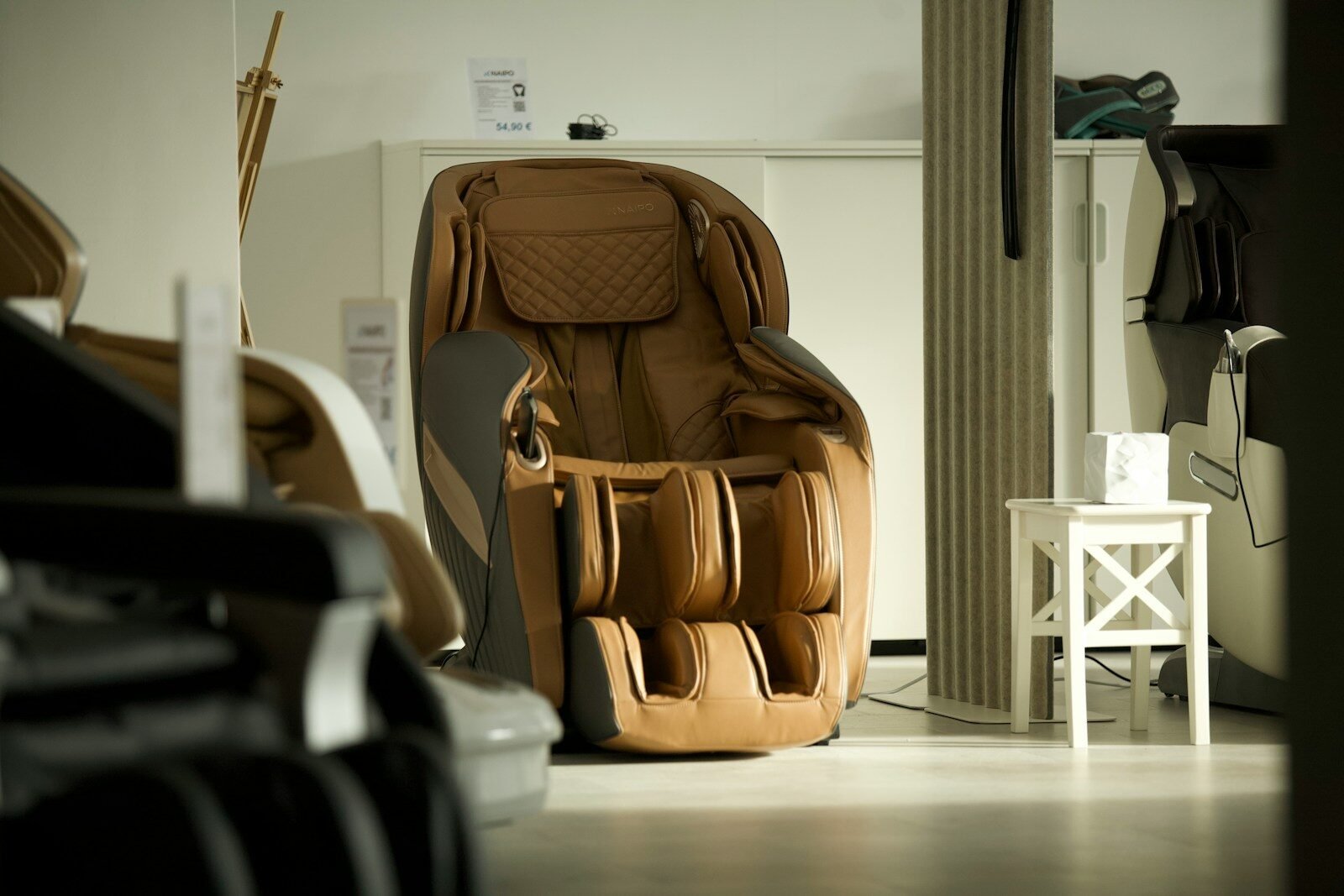
Buying a perfect massage chair is not like choosing an ordinary recliner. A comfortable-looking chair can still be a poor purchase if the massage rollers do not line up with your body, the track does not reach the areas you care about, the chair cannot fit properly in your room, or the warranty becomes difficult to use when something goes wrong.
The biggest mistake is starting with the longest feature list.
A better approach is to start with what you want the chair to do, then work backward through massage technology, body fit, available space, comfort, controls, warranty and price. Current buying guides consistently emphasize the same core factors: physical needs, track type, body dimensions, room fit, features and after-sales support. (JC BUCKMAN PK)
This guide explains what those specifications actually mean and which ones deserve the most attention before you spend your money.
What Should You Look for in a Massage Chair?
The right massage chair should match your body, your preferred massage style, your available space and your realistic budget.
Before buying, check these areas:
- Massage track: S-track, L-track or SL-track.
- Roller technology: Understand the difference between 2D, 3D and 4D.
- Body fit: Check the manufacturer’s height and weight recommendations.
- Massage intensity: Make sure pressure can be adjusted.
- Air compression: Check which parts of the body actually receive compression.
- Heat: Determine where the heating elements are located.
- Zero-gravity recline: Consider whether the reclining position improves your preferred massage experience.
- Foot and calf massage: Check whether the foot section fits your legs and feet.
- Room requirements: Measure the chair upright and fully reclined.
- Warranty and service: Look beyond the headline warranty period.
- Return policy: A large chair is difficult and expensive to return.
- Safety: If you have a medical condition, recent injury, pregnancy or other relevant concern, ask your healthcare professional before using massage equipment.
The most expensive chair is not automatically the right chair. The goal is to find the chair whose important features correspond to how you will actually use it.
Start With Your Massage Needs
Before comparing brands, ask a simpler question:
Why do I want a massage chair?
Your answer should influence almost every other decision.
Someone who wants occasional relaxation after work may have very different priorities from someone who wants extensive back and lower-body coverage.
For example, you might want:
- General relaxation
- Neck and shoulder massage
- Back massage after sitting at a desk
- Lower-back and hip coverage
- Leg and calf compression
- Foot massage
- Gentle massage rather than strong pressure
- A chair for multiple people in the household
Write down your top three priorities before looking at models.
This prevents a common buying mistake: becoming impressed by features that sound sophisticated but do not solve your actual problem.
Think in terms of use cases
If you primarily want relaxation, you may care more about comfortable reclining, adjustable intensity, heat and easy-to-use programs.
If you specifically want extensive lower-body coverage, the track design becomes much more important.
If several people will use the chair, adjustable intensity, body scanning, multiple user settings and a wide range of massage programs may become more valuable.
The right feature depends on the person using it.
Understand Massage Chair Track Types
The track is one of the most important mechanical components because it determines the path along which the massage rollers travel.
You will commonly encounter S-track, L-track and SL-track designs.
| Track type | General roller path | What to consider |
|---|---|---|
| S-track | Follows the natural curve of the spine | Useful when back and upper-body coverage is the main priority |
| L-track | Extends farther downward from the back | Provides additional lower-body coverage |
| SL-track | Combines an S-shaped path with extended coverage | Useful when you want both spinal and lower-body coverage |
An S-track follows the body’s spinal curve. L-track designs extend the roller path farther down the chair, while SL-track systems combine the curved spinal path with extended lower-body coverage. (JC BUCKMAN PK)
Does a longer track automatically mean a better chair?
No.
Longer coverage can be useful, but track length should be considered alongside roller quality, body fit, massage intensity and the areas you actually want treated.
If you mainly care about upper-back and shoulder massage, paying substantially more solely for extended lower-body coverage may not make sense.
If lower-back, hip or glute coverage is important to you, however, track design deserves much more attention.
2D vs. 3D vs. 4D Massage Rollers
Another specification that appears frequently in massage chair marketing is roller technology.
The terminology can be confusing because roller technology and track type describe different things.
A track describes where the rollers travel.
Roller technology describes how the rollers move.
2D rollers
Traditional 2D systems generally move in the primary directions along the massage track.
They can provide basic kneading, rolling and other massage movements without the additional depth adjustment found in more advanced systems.
For someone who wants basic home relaxation, this may be sufficient.
3D rollers
3D systems add adjustable depth, allowing the rollers to move farther toward or away from the body.
This can give the user more control over massage pressure.
4D rollers
4D systems add another layer of dynamic movement, typically allowing changes in roller speed and rhythm alongside depth adjustment.
The important point is that 4D does not mean the chair automatically provides a better massage for every person.
If you are comparing two chairs, ask what the roller system actually allows you to adjust rather than assuming a larger number means a better fit.
A 3D chair with excellent body fit and useful intensity controls may be more practical for one buyer than a poorly fitted 4D chair.
Body Fit Matters More Than Many Buyers Realize
A massage chair can have impressive specifications and still feel wrong if its massage path does not line up properly with your body.
Before purchasing, check:
- Recommended user height
- Maximum user weight
- Shoulder positioning
- Calf and foot positioning
- Roller alignment
- Seat dimensions
- Armrest dimensions
- Footrest dimensions
Manufacturers publish recommended height and weight ranges, but simply falling inside that range does not guarantee perfect positioning.
This is particularly important if you are considerably taller or shorter than average.
What should you check in a showroom?
If possible, sit in the chair before buying.
Pay attention to whether:
- The shoulder airbags sit around your shoulders rather than too high or too low.
- The rollers travel along the areas you expect.
- Your feet sit naturally inside the foot compartments.
- Your calves are positioned correctly.
- The chair feels comfortable when reclined.
- The strongest massage setting is actually tolerable.
Don’t judge the chair after only a few seconds.
Spend enough time in different programs and intensity levels to understand how the chair feels.
Adjustable Massage Intensity Is Extremely Important
A massage chair that only feels good at one pressure level may become frustrating over time.
Different people have different pressure preferences.
Even the same person may want different intensity depending on the day.
Look for controls that allow you to adjust things such as:
- Roller intensity
- Airbag pressure
- Massage speed
- Massage area
- Massage technique
- Heat
- Recline position
More adjustment generally gives a household more flexibility.
This becomes particularly useful when two people with very different massage preferences share one chair.
Check the Massage Techniques
Massage chairs can offer a variety of programmed techniques, but a large number of programs is not necessarily meaningful by itself.
Depending on the model, you may encounter options based on techniques such as:
- Kneading
- Rolling
- Tapping
- Shiatsu-style movements
- Combination programs
- Targeted massage
- Full-body programs
Instead of asking “How many programs does it have?”, ask:
“Can I control the massage in the areas I actually care about?”
Ten useful programs that you understand may be more valuable than dozens of programs you rarely use.
Don’t Ignore Air Compression
Airbags are used in many massage chairs to provide compression around areas such as:
- Shoulders
- Arms
- Hands
- Hips
- Thighs
- Calves
- Feet
The number of airbags is sometimes used as a marketing headline, but the number alone tells you relatively little.
What matters is where they are located and what control you have over them.
For example, a chair may have many airbags but limited adjustment options.
Another chair might have fewer airbags but place them in areas that matter more to you.
So don’t simply compare “30 airbags vs. 50 airbags.”
Compare the actual coverage.
Heat Therapy: Useful, But Check the Details
Heat is another popular massage-chair feature.
It can make a massage session feel more relaxing, particularly when warmth is applied around the lower back or other designated areas.
But don’t assume that every chair with “heat therapy” provides full-body heating.
Check:
- Where the heating elements are located
- Whether heat can be turned on independently
- Whether the temperature or intensity is adjustable
- Whether heat operates with every massage program
- Whether the manufacturer gives specific instructions for its use
Heat should be considered a comfort feature rather than a reason to ignore the chair’s core mechanical design.
What Is Zero Gravity?
Zero-gravity recline is one of the most recognizable features in premium massage chairs.
The chair reclines the user into a position intended to distribute body weight more evenly while the massage operates.
It can make the massage experience feel different from sitting upright.
But you should treat zero gravity as a positioning and comfort feature, not as proof that a chair provides superior massage.
If you are comparing two chairs, consider zero gravity alongside:
- Roller quality
- Track design
- Body fit
- Reclining range
- Comfort
- Space requirements
A chair with excellent massage mechanics but an uncomfortable fit is still a poor match for you.
Measure Your Room Before You Order
This is one of the easiest mistakes to prevent.
Massage chairs are large pieces of furniture, and their dimensions can change significantly when they recline.
Don’t measure only the space where the chair will stand upright.
Measure:
Chair width + upright depth + fully reclined depth + surrounding clearance
Also check doorways, hallways, elevators and staircases if the chair needs to be carried into another room.
Some models use space-saving mechanisms that allow the chair to recline closer to a wall, but you should verify the manufacturer’s actual clearance requirements.
Make a simple measurement checklist
Before ordering, record:
| Measurement | What to check |
|---|---|
| Door width | Can the packaged chair enter? |
| Hallway width | Can delivery staff move it through? |
| Room width | Enough space beside the chair? |
| Upright depth | Does it fit in normal position? |
| Reclined depth | Is there enough space when fully extended? |
| Ceiling/door clearance | Any obstruction during movement? |
| Power outlet | Is a suitable outlet nearby? |
This five-minute measurement exercise can prevent a very expensive logistical problem.
Consider Who Will Use the Chair
A massage chair for one person has different requirements from a chair used by an entire family.
For multiple users, consider:
Adjustable intensity
Different users may prefer different pressure.
Body scanning
Some chairs use sensors to help position massage movements according to the user’s body.
Easy controls
A complicated interface can discourage people from using the chair regularly.
Multiple programs
Different users may want different massage styles.
Height compatibility
Make sure the household’s tallest and shortest users are both within the manufacturer’s recommended range.
Look at the Control System
A massage chair can have excellent hardware but still be annoying to use if its controls are confusing.
Check whether the chair uses:
- Physical buttons
- Remote control
- Touchscreen
- Smartphone controls
- Voice control
- Preset programs
More technology is not automatically better.
A simple remote with clear controls can be more convenient than an elaborate interface that requires several steps to start a basic massage.
If possible, operate the controls before buying.
Warranty and After-Sales Support May Matter More Than Another Feature
A massage chair contains motors, electronics, airbags, rollers and moving components.
That means after-sales support deserves serious attention.
Don’t just ask:
“How long is the warranty?”
Ask:
- What parts are covered?
- Is labor included?
- Is the frame covered separately?
- Are electronics covered?
- Who performs repairs?
- Where is the service center?
- Are replacement parts available locally?
- Who pays shipping?
- Does the warranty apply if you buy through a marketplace?
- What happens if the chair needs to be transported for repair?
Current buying guides specifically recommend examining warranty coverage and local service rather than treating the warranty headline as sufficient. (Massage Chair Finder)
A cheap chair with difficult-to-obtain replacement parts can become much more expensive after a failure.
Don’t Ignore the Return Policy
A massage chair is a large, heavy product.
Returning a pair of headphones is relatively simple.
Returning a large massage chair is not.
Before buying online, find out:
- How many days you have to return it
- Whether the chair must be unused
- Whether return shipping is charged
- Whether a restocking fee applies
- Who arranges collection
- Whether the original packaging is required
- Whether the seller offers an in-home trial
The FDA’s general guidance for home-use devices also recommends checking the reliability of the seller, return policy and customer support before purchasing a device online. (U.S. Food and Drug Administration)
Buy From a Seller You Can Actually Contact
Price comparison is useful, but the cheapest listing is not necessarily the lowest-cost purchase.
Before paying, verify:
- Seller identity
- Warranty terms
- Return policy
- Customer-service contact information
- Delivery arrangements
- Installation or setup support
- Replacement-part availability
If something goes wrong six months later, you want to know exactly who is responsible.
This becomes particularly important with imported products or marketplace sellers.
Check Electrical Requirements
Massage chairs are powered electrical appliances, so make sure the chair is compatible with your local electrical system.
Check:
- Voltage
- Frequency
- Plug type
- Power requirements
- Manufacturer instructions
If you are importing a chair, don’t assume an international model is automatically suitable for your home’s electrical supply.
The FDA’s home-use guidance similarly emphasizes checking power sources and outlet compatibility when using electrical devices at home. (U.S. Food and Drug Administration)
Be Careful With Medical Claims
This is an important distinction.
A massage chair can be a wellness and relaxation product, but that does not mean it should automatically be treated as a medical treatment for a diagnosed condition.
Marketing phrases such as “pain cure,” “treats sciatica,” “fixes spinal problems” or “replaces physiotherapy” deserve scrutiny.
Massage therapy itself may have potential benefits for relaxation, stress and some forms of pain, but medical suitability depends on the individual and evidence for specific conditions varies. Mayo Clinic notes that people with certain conditions should consult their healthcare team before massage. (Mayo Clinic)
Who Should Be Especially Careful?
Talk with a healthcare professional before using massage equipment if you have relevant medical conditions or circumstances such as:
- A recent heart attack
- A bleeding disorder
- Blood-thinning medication
- A recent blood clot
- Unhealed fractures
- Severe osteoporosis
- Recent surgery
- Significant nerve damage
- Certain cardiovascular conditions
- High-risk pregnancy
- Other conditions where strong pressure or reclining could be inappropriate
Mayo Clinic and Cleveland Clinic both identify several situations where massage requires additional precautions or medical guidance. (Mayo Clinic)
If you are pregnant, have an implanted medical device, have a blood-clotting concern, or have recently suffered an injury or undergone surgery, don’t rely on a product listing to determine whether a massage chair is appropriate for you.
Common Massage Chair Buying Mistakes
Buying the most expensive model
A higher price can provide additional technology, but you may never use some of those features.
Choosing by the number of airbags
Airbag quantity does not tell you whether the coverage suits your body.
Choosing 4D because the number sounds better
4D is a description of roller movement, not a universal quality rating.
Ignoring body size
A chair can technically support your height while still producing poor roller positioning.
Forgetting reclined dimensions
A chair that fits upright may not fit when fully reclined.
Looking only at the warranty length
A five-year warranty is not very useful if the parts you are most likely to need are excluded.
Buying without trying it
If you have access to a showroom, testing different programs can reveal comfort differences that specifications cannot communicate.
Assuming massage should hurt
Strong pressure is not automatically more effective. Mayo Clinic advises that massage should not cause severe pain and recommends reducing pressure if it feels too strong. (Mayo Clinic)
A Practical Massage Chair Buying Framework
If you feel overwhelmed by dozens of specifications, use this order:
Step 1: Define your main purpose
Relaxation? Back massage? Full-body coverage? Foot and calf massage?
Step 2: Set your maximum budget
Decide the ceiling before shopping.
Step 3: Choose the track
Determine whether S, L or SL coverage fits your priorities.
Step 4: Compare roller technology
Decide whether 2D, 3D or 4D movement provides features you will actually use.
Step 5: Confirm body fit
Check height, weight, shoulder, calf and foot positioning.
Step 6: Check essential features
Look at intensity adjustment, heat, airbags, foot massage and reclining positions.
Step 7: Measure your room
Measure both upright and reclined dimensions.
Step 8: Research warranty and service
Find out who will repair the chair if something fails.
Step 9: Check delivery
Confirm how the chair will enter your home and where it will be installed.
Step 10: Review the return policy
Know your options before you pay.
This approach reduces the temptation to compare every specification at once.
Perfect Massage Chair Feature Checklist
| Feature | Why it matters | What to ask |
|---|---|---|
| Track | Determines roller coverage | Where does it start and stop? |
| Roller technology | Determines roller movement | Can depth and intensity be adjusted? |
| Body scanning | Helps personalize positioning | How does the system detect body position? |
| Air compression | Provides squeeze-and-release pressure | Which body areas are covered? |
| Heat | Adds warmth during sessions | Where is heat applied? |
| Zero gravity | Changes reclining position | How many positions are available? |
| Foot massage | Targets feet and calves | Does the foot compartment fit you? |
| Controls | Determines ease of use | Can you easily adjust intensity and areas? |
| Warranty | Protects your purchase | What parts and labor are covered? |
| Service | Determines what happens after failure | Who performs repairs? |
| Return policy | Reduces buying risk | Who pays return shipping? |
| Dimensions | Determines whether it fits | What are upright and reclined measurements? |
How Much Should You Spend to choose the perfect massage chair?
There is no single price that makes a massage chair “worth it.”
The useful question is:
What are you paying extra for?
A higher-priced model may add:
- More advanced roller movement
- Longer massage coverage
- More adjustment options
- More sophisticated body scanning
- Better foot and calf systems
- More air-compression zones
- More reclining options
- Additional controls or smart features
But the value of those upgrades depends on whether you actually need them.
A buyer who wants occasional relaxation may have little reason to pay for every premium feature.
Someone who plans to use the chair frequently and wants highly adjustable massage may place more value on advanced mechanisms.
The best purchase is therefore not necessarily the cheapest or most expensive one. It is the one where the important features justify the additional cost for your specific use case.
Questions to Ask Before Buying Perfect Massage Chair
Before clicking “Buy,” you should be able to answer all of these:
- What area of my body do I want the chair to focus on?
- Which track does it use?
- What type of rollers does it have?
- Can I adjust massage intensity?
- Does it fit my height and weight?
- Do my shoulders line up correctly?
- Do my feet and calves fit comfortably?
- Where does the heat work?
- Which areas receive air compression?
- How far does the chair extend when reclined?
- Can it physically enter my home?
- What does the warranty actually cover?
- Who repairs it?
- Are replacement parts available?
- What is the return policy?
- Is the seller authorized or otherwise reputable?
- Are the electrical requirements compatible with my home?
- Do I need medical advice before using it?
If you cannot answer several of these questions, you probably need more information before purchasing.
Frequently Asked Questions
Is a massage chair worth buying?
It can be worthwhile for someone who values having convenient massage and relaxation at home, but value depends on usage frequency, price, comfort and whether the chair actually matches the user’s needs.
Is 3D or 4D massage better?
3D and 4D describe different levels of roller movement. 4D systems generally add more dynamic control over roller movement, but that does not automatically make every 4D chair a better fit for every user.
Is an SL-track massage chair better?
SL-track provides extended roller coverage while following a curved path along the back. It can be useful for buyers who specifically want more lower-body coverage, but it is not automatically necessary for every user.
How important is zero gravity?
Zero gravity is mainly a reclining and positioning feature. It can improve comfort during a massage, but it should be evaluated alongside the chair’s roller system, track, body fit and overall comfort.
Should I buy a massage chair online?
You can, but carefully check seller reputation, warranty, return terms, delivery requirements and customer support before purchasing. Large products can be significantly more difficult to return than ordinary online purchases. (U.S. Food and Drug Administration)
Can everyone safely use a massage chair?
No. People with certain medical conditions, recent injuries, blood-clotting concerns, some cardiovascular conditions, recent surgery or high-risk pregnancy may need professional medical advice before massage. (Mayo Clinic)
How long should a massage-chair session last?
Follow the manufacturer’s instructions for the specific chair rather than assuming that longer sessions are always better. Start conservatively, especially if you are new to massage or sensitive to pressure.
Final Verdict: How to Choose the Perfect Massage Chair
Choosing a massage chair becomes much easier when you stop treating it as a competition between feature lists.
Start with your body and your intended use.
Then evaluate the track, roller system, intensity controls, air compression, heat, foot massage and reclining features. After that, check whether the chair actually fits your body and your room.
Finally, investigate the less exciting parts of the purchase: warranty coverage, service, delivery, electrical compatibility and returns.
Those details may not look impressive in a product advertisement, but they can have a major effect on whether the purchase remains satisfying after the initial excitement disappears.
The perfect massage chair is therefore not necessarily the chair with the most airbags, the biggest screen, the highest number of programs or the most expensive 4D system.
It is the chair whose massage technology, body fit, comfort, space requirements, support and price make sense for the way you will actually use it.
Relevant existing TrendCritique Articles for your Buying Guide
- Standing Desk vs. Desk Converter — prolonged desk work and home comfort. (Trend Critique)
- Robot Vacuum vs. Traditional Vacuum — useful for a broader home-buying/decision-framework cluster. (Trend Critique)
- DIY Guide to Must-Have Tools — (Trend Critique)
External sources
- Mayo Clinic — Massage Therapy: safety considerations, risks and situations requiring healthcare guidance. (Mayo Clinic)
- Cleveland Clinic — Massage Therapy: precautions involving blood thinners, blood clots, osteoporosis, implanted devices and recent injuries. (Cleveland Clinic)
- FDA — Home Use Devices: considerations for safe home use, reliable sellers, return policies and power compatibility. (U.S. Food and Drug Administration)
- FDA — Home Health and Consumer Devices: broader guidance concerning safe use of consumer devices at home. (U.S. Food and Drug Administration)
Author Bio
TrendCritique Editorial Team
TrendCritique Editorial Team publishes independently researched reviews, buying guides, comparisons, explainers and consumer-focused analysis. Its editorial approach emphasizes source verification, balanced evaluation, practical buying advice and clear separation between documented claims and editorial conclusions.