
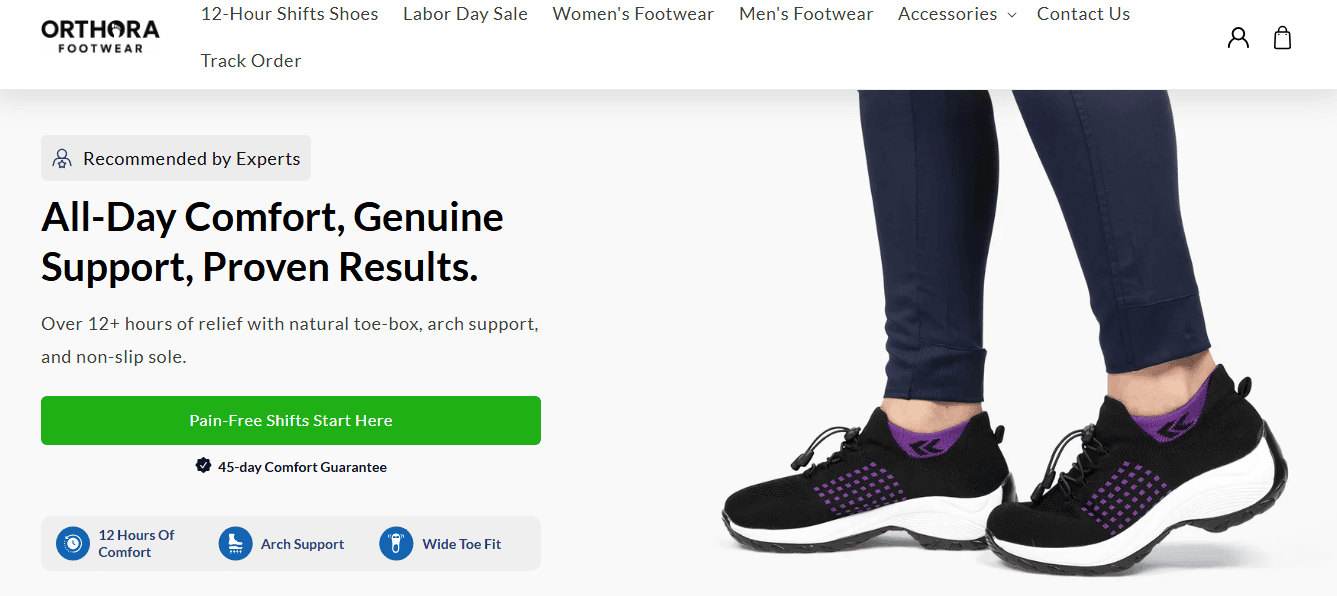
Orthora Footwear is an online shoe retailer positioning its products primarily around comfort, support, and long periods of standing or walking. Its current website highlights shoes designed for workers who spend extended periods on hard floors, while also marketing features and collections aimed at people concerned about foot discomfort, plantar fasciitis, bunions, swelling, and related problems.
At first glance, the proposition is straightforward: affordable-looking footwear marketed toward people who need comfort during demanding workdays.
The more useful question is whether the available evidence supports the stronger claims.
Our assessment is mixed. Orthora has a functioning retail operation, a published customer-service and returns system, multiple shoe collections, and a substantial volume of public customer feedback. At the same time, customer experiences vary considerably, particularly around sizing, perceived quality, delivery, and returns. Orthora’s own published policies also contain conditions that buyers should understand before relying on the advertised “wear test.”
Most importantly, buyers should not interpret the word “orthopedic” or claims about plantar-fasciitis relief as proof that a particular shoe will treat a medical condition. Supportive footwear can be useful for some people, but persistent or significant foot pain deserves appropriate medical evaluation.
What Is Orthora Footwear?
Orthora Footwear is an online footwear brand that describes itself as focused on workers who spend much of their day standing and walking.
Orthora Footwear current product range includes the Orthora Pro, ShiftPro, OrthoSlip, CloudLift, breathable no-tie shoes, recovery slides, compression socks, and various insoles. The company organizes products into collections including OrthoCare, OrthoInsoles, comfort-relief footwear, and recovery products.
The company’s About page says its focus is workers, including nurses, warehouse workers, restaurant employees, and retail workers. It also claims that more than 500,000 U.S. workers trust Orthora. That is a company claim, rather than an independently verified TrendCritique statistic, so readers should treat it accordingly.
This distinction matters throughout the review.
A brand can describe its shoes as supportive or suitable for long shifts, but that does not establish that every wearer will experience the same result.
What Does Orthora Sell?
Orthora’s current catalog is broader than a single “orthopedic shoe.”
The main categories include:
| Product/category | Intended positioning |
|---|---|
| Orthora Pro | Long-shift work and comfort |
| ShiftPro | Long-shift comfort and foot support |
| OrthoSlip | Everyday slip-resistant footwear |
| CloudLift | Cushioned/support-oriented footwear |
| No-Tie Stretch Shoes | Convenience and flexible fit |
| Recovery Slides | Post-work/recovery use |
| OrthoInsoles | Additional in-shoe support |
| Compression Socks | Compression/support accessory |
The company also promotes features such as slip resistance, breathable materials, stable heel construction, and cushioning on certain products.
However, these features should be evaluated at the individual product level. A feature advertised for one model should not automatically be assumed to apply identically across the entire Orthora range.
Orthora Pro: The Main Product to Know
The Orthora Pro is currently one of the brand’s most prominently promoted shoes.
The official product pages position it as a unisex shoe for long shifts and advertise features including a slip-resistant work grip, stable heel, breathable mesh, and a durable outsole. The company also markets it for people seeking relief from heel and plantar-fasciitis discomfort.
The official site currently lists the Orthora Pro at $59.95, with a crossed-out $200 figure and a promotional discount displayed on the site. Because online promotions can change, this should be regarded as the price observed during this review rather than a permanent price.
The important caveat
A product page describing a shoe as capable of providing pain relief is not the same thing as independent clinical evidence demonstrating that result.
Mayo Clinic recommends supportive shoes with features such as good arch support, cushioning, and adequate sole thickness for people managing plantar fasciitis, but footwear is only one part of the broader treatment picture.
Therefore, Orthora’s comfort-oriented design may be relevant to someone looking for supportive footwear, but the company’s marketing should not be interpreted as proof that the shoes will treat plantar fasciitis or another medical condition.
Are Orthora Shoes Actually Orthopedic?
This is where buyers should be careful with terminology.
Orthora uses terms such as “orthopedic,” “arch support,” “plantar fasciitis relief,” and “foot pain relief” throughout its marketing.
But “orthopedic” in a product description does not automatically mean that a shoe has been medically prescribed or individually fitted by a medical professional.
There is also no evidence in the sources reviewed for this article that establishes Orthora shoes as a treatment for a particular medical condition.
That does not mean the shoes cannot be comfortable. It means buyers should separate two different questions:
Question 1: Could these shoes feel supportive and comfortable?
Potentially, yes.
Question 2: Are they clinically proven to treat my specific foot problem?
The evidence reviewed here does not establish that.
For persistent plantar-fasciitis symptoms, Mayo Clinic recommends supportive footwear but also discusses stretching, activity modification, and other treatment options.
What Does the Medical Evidence Say About Supportive Shoes?
This is an important context that many shoe reviews leave out.
Mayo Clinic advises people with plantar fasciitis to choose supportive shoes with good arch support, thick soles, and cushioning, while avoiding flat shoes and barefoot walking.
The American Academy of Family Physicians similarly notes that properly fitting, appropriate shoes may be useful for some people with plantar fasciitis and that thicker, cushioned midsoles can reduce discomfort during prolonged walking or standing.
But the evidence is more nuanced than simply saying “orthopedic shoes cure plantar fasciitis.”
A 2019 American Family Physician review reported that foot orthoses may reduce heel pain over the short term, but the long-term benefit is generally not clinically meaningful.
That makes the correct takeaway relatively simple:
A supportive shoe can be part of a sensible footwear choice, but it should not be treated as a guaranteed medical solution.
Orthora Footwear Sizing: One of the Biggest Questions
Sizing deserves special attention because Orthora’s own pages are not completely consistent.
One official Orthora size-chart page says the shoe has a standard fit and recommends ordering your usual size, with people between sizes advised to choose the larger size. It also recommends measuring foot length and comparing it with the chart.
However, certain Orthora product pages say something different: they recommend ordering one size up, particularly for people between sizes, those with wider feet, bunions, swelling, high insteps, thick socks, or those wanting additional room during long shifts.
That discrepancy is worth noticing.
What should buyers do?
Don’t rely solely on the headline “true to size” message.
Instead:
- Measure your feet.
- Check the size chart for the exact product.
- Consider the socks you normally wear.
- Think about whether your feet swell during long shifts.
- Check the product-specific sizing instructions.
- Keep the return/exchange conditions available before ordering.
Public customer feedback also shows that sizing is one of the more inconsistent parts of the buying experience. Some reviewers report shoes running small, while others report them running large.
That doesn’t establish a universal sizing problem, but it does mean buyers should approach sizing carefully.
What Are Customers Saying About Orthora?
Public reviews are particularly useful here because they reveal a more complicated picture than the product pages.
Trustpilot currently shows Orthora Footwear with a 4.0/5 TrustScore and more than 1,500 reviews on the page reviewed for this article. Its review distribution shown on the page is 60% five-star, 13% four-star, 5% three-star, 3% two-star, and 19% one-star.
Those figures should not be interpreted as a controlled product-quality study. Trustpilot itself explains that reviews represent individual customer opinions and that the company had not recently invited customers to review, meaning the review population may not be representative.
Still, the pattern is informative.
Positive themes
Positive reviewers commonly mention:
- Easy ordering
- Responsive customer service
- Comfortable shoes
- Successful size replacements
- Attractive designs
- Reasonable perceived pricing
For example, some reviewers report that customer service helped them obtain replacement sizes after fit problems.
Negative themes
Negative reviews raise concerns about:
- Sizing
- Shoe quality
- Comfort
- Delivery delays
- Refund experiences
- Return costs
- Expectations created by the marketing
Several recent Trustpilot reviews also complain about orders taking longer than expected or not arriving when anticipated.
The important point is not that every negative review is necessarily representative. It is that the same categories of complaints appear repeatedly enough to deserve consideration before purchase.
What Does the BBB Record Show?
The Better Business Bureau currently lists Orthora Footwear as a shoes business and says the business is not BBB accredited. Its profile states that the BBB file was opened in February 2026 and lists the business as having started in October 2025.
The BBB customer-review page currently contains complaints involving issues such as:
- Delayed delivery
- Sizing discrepancies
- Product-quality concerns
- Return difficulties
- Disagreement over refund resolutions
These are customer allegations and should be treated as such—not as independently proven findings about every Orthora order.
The company has responded to some BBB complaints, stating that it communicated with customers and worked toward resolutions.
Does this mean Orthora is a scam?
The available evidence does not justify that conclusion.
There are documented customers who report satisfactory purchases and responsive support, alongside customers who report significant problems.
A more accurate editorial conclusion is that buyers should understand the company’s return, sizing, and delivery conditions before placing an order.
That is more useful than applying an unsupported “scam” or “legit” label to a mixed body of customer experiences.
Orthora’s 45-Day Wear Test: Read the Fine Print
Orthora prominently advertises a 45-day comfort or wear guarantee. Its return-policy page, however, contains several conditions that buyers should understand.
According to the published policy:
- Shoes covered by the comfort guarantee must be worn for a minimum of 3–5 full working days.
- Customers may need to provide photo or video evidence of the issue.
- The company may offer a size exchange, replacement, or adjustment guidance.
- Certain promotional or clearance purchases are excluded.
- Normal wear and tear is excluded.
- Some subjective comfort concerns are excluded.
This is substantially more specific than simply saying “wear the shoes for 45 days and return them if you don’t like them.”
The standard return rules are even more important
Orthora’s published return policy says standard returns generally require the shoes to be unused, unworn, and in original condition.
For standard returns such as changing your mind or ordering the wrong size, the customer is responsible for return shipping. The company says shipping is covered when the item is defective, damaged in transit, or the wrong product was sent.
That means the advertised wear guarantee and the standard return policy should not be treated as exactly the same thing.
There Is a Policy Inconsistency Buyers Should Notice
Orthora’s size-chart page currently refers to a 60-day money-back guarantee, while the company’s dedicated return-policy page describes a 45-Day Comfort Guarantee and a 45-day return window.
This is a meaningful inconsistency.
It may simply reflect an outdated page or marketing copy, but a buyer should not have to guess which policy controls an actual return.
Before purchasing, check the current dedicated return policy and save a copy of it.
This is particularly important when buying footwear online because fit is inherently difficult to judge without trying the product.
Shipping: Another Area Worth Checking
Orthora’s delivery page says U.S. orders receive free shipping and lists:
- Processing: 1–5 business days
- U.S. delivery: 4–7 business days
- Estimated total: approximately 5–12 business days
International delivery times may vary.
Those are estimates, not guaranteed delivery dates.
This matters because recent customer reviews include complaints about delays and uncertainty surrounding expected delivery.
If you need shoes for a specific work start date, don’t assume an advertised estimate is a guaranteed arrival date.
Orthora Footwear Pros and Cons
Pros
- Wide range of comfort-oriented footwear and accessories.
- Products are explicitly marketed toward people who spend long periods standing or walking.
- The company publishes sizing, shipping, and return information.
- Some customers report comfortable shoes.
- Some customers report helpful customer-service interactions.
- Several models advertise features such as slip resistance and cushioning.
- A formal comfort/exchange policy is published.
Cons
- Customer experiences with sizing are inconsistent.
- Public complaints include perceived quality problems.
- Some customers report delivery delays.
- Standard returns can involve customer-paid return shipping.
- The 45-day guarantee has conditions that are easy to overlook.
- Orthora’s own pages contain inconsistent references to 45-day versus 60-day guarantees.
- Strong health-related marketing should not be confused with independent clinical evidence.
- No hands-on TrendCritique testing was conducted for this review.
Who Might Consider Orthora?
Orthora may be worth considering if you:
- Spend many hours standing or walking at work.
- Want a casual or work-oriented comfort shoe.
- Prefer ordering footwear online.
- Are willing to measure your feet carefully.
- Value features such as cushioning and slip-resistant positioning.
- Understand that comfort is individual.
The strongest potential use case is the buyer who needs general supportive work footwear, rather than someone looking for a medically proven treatment for a specific foot disorder.
Who Should Be More Cautious?
Consider alternatives or professional advice first if:
- You have persistent or severe foot pain.
- You have a diagnosed condition requiring specialized footwear.
- You require a specific prescription orthotic.
- You have significant swelling or unusual foot shape.
- You cannot tolerate the risk of an online sizing process.
- You need guaranteed delivery by a particular date.
- You are uncomfortable paying return shipping if the fit is wrong.
For people with ongoing plantar-fasciitis symptoms, shoe selection can be useful, but it should not replace appropriate medical assessment and treatment.
Is Orthora Footwear Worth the Money?
There isn’t enough independent evidence to give every Orthora model a blanket “yes” or “no.”
The value proposition depends heavily on what you expect.
If you simply want an affordable-looking comfort shoe for standing and walking, Orthora has products designed around that use case.
If you expect a shoe marketed as “orthopedic” to provide medically established treatment for plantar fasciitis, the evidence available for this review does not support that expectation.
And if your biggest concern is hassle-free returns, the published conditions deserve careful attention before purchasing.
The better way to evaluate the price
Don’t compare only the advertised sale price.
Consider:
Purchase price + potential return shipping + sizing risk + delivery time + expected durability
A low initial price becomes less attractive if the shoe does not fit and returning it costs additional money.
Orthora vs. a Conventional Athletic Shoe
The choice isn’t necessarily between Orthora and another “orthopedic” shoe.
A good conventional walking or running shoe may already provide many characteristics people seek in supportive footwear.
Mayo Clinic recommends supportive shoes with cushioning, adequate sole thickness, and arch support for people dealing with plantar fasciitis.
So before buying Orthora, consider whether you already have access to a well-fitting athletic shoe that meets those requirements.
The key comparison is not:
Orthora vs. orthopedic shoe
It is:
Which shoe fits my foot, supports my intended activity, and meets my comfort requirements?
That is a much more useful purchasing question.
How to Buy Orthora More Safely
If you decide to try Orthora, use this process.
1. Measure both feet
Don’t assume the size you wear in another brand will automatically transfer.
2. Read the product-specific sizing instructions
Orthora’s pages don’t all give exactly the same sizing recommendation.
3. Read the return policy before paying
Pay particular attention to return shipping, wear conditions, promotional exclusions, and the 45-day deadline.
4. Save your order information
Keep your confirmation email, tracking information, product page, and the applicable return policy.
5. Don’t assume medical benefits
Treat claims about pain relief as marketing claims unless supported by independent evidence.
6. Check delivery estimates
If you need shoes for work immediately, allow more time than the minimum estimated window.
7. Evaluate fit early
If something feels wrong, don’t simply assume that more wear will solve it. Review the applicable exchange or guarantee terms.
Frequently Asked Questions
Is Orthora Footwear legit?
Orthora operates an online footwear store and has a substantial volume of public customer feedback. Its official site publishes product, shipping, and return information. However, customer experiences are mixed, particularly regarding sizing, quality, delivery, and returns. The BBB currently lists the company as not BBB accredited.
Are Orthora shoes good for plantar fasciitis?
Orthora markets certain shoes for plantar-fasciitis-related discomfort, but that marketing should not be interpreted as proof that the shoes treat the condition. Supportive shoes with cushioning and arch support can be part of plantar-fasciitis self-care, according to Mayo Clinic, but treatment is broader than simply buying a particular shoe.
Do Orthora shoes run true to size?
There isn’t a completely consistent answer from either the company’s own pages or customer feedback. One official size page recommends the usual size, while some product pages recommend going one size up in certain circumstances. Customer reviews report both tight and oversized fits.
What is Orthora’s return policy?
Orthora currently advertises a 45-day comfort guarantee, but its policy includes conditions involving wear, evidence, promotional purchases, return shipping, and refund eligibility. Standard returns generally require unused and unworn shoes, while certain defective or incorrect orders qualify for company-paid return shipping.
Does Orthora offer free returns?
Not universally. Orthora’s policy says return shipping is covered for manufacturing defects, transit damage, or incorrect items. For standard returns such as changing your mind or ordering the wrong size, the customer pays return shipping.
How long does Orthora shipping take?
Orthora currently states that U.S. orders typically require 1–5 business days for processing plus 4–7 business days for delivery, for an estimated total of about 5–12 business days. International shipping times can vary.
Should I buy Orthora instead of a regular running shoe?
Not automatically. A well-fitting conventional walking or running shoe may provide many of the same basic characteristics you are looking for, such as cushioning and support. The best choice depends on your foot shape, activity, comfort requirements, and the specific shoe.
Final Verdict
Orthora Footwear is a brand worth researching carefully, not blindly trusting or automatically dismissing.
Its strongest proposition is clear: footwear designed and marketed toward people who spend long periods on their feet. The company offers multiple styles, publishes sizing and shipping information, and has many customers who report positive ordering and customer-service experiences.
But there are meaningful reasons to remain cautious.
Sizing feedback is inconsistent. Public complaints include quality and delivery concerns. Standard return shipping can fall on the customer. And the company’s own pages currently contain a notable discrepancy between a 45-day and 60-day guarantee reference.
The medical side also deserves restraint. Orthora’s shoes may be supportive, but the available evidence reviewed here does not establish them as a clinically proven treatment for plantar fasciitis or other foot disorders.
Our bottom line
Best reason to consider Orthora: You want reasonably priced, comfort-focused footwear specifically marketed for long periods of standing or walking.
Biggest concern: The gap between the confident marketing and the mixed independent customer experiences, particularly around fit, quality, delivery, and returns.
Best buyer: Someone willing to measure carefully, read the current return policy, and judge the shoes primarily as footwear rather than medical treatment.
Who should look elsewhere: Anyone requiring prescription-level or condition-specific footwear, guaranteed delivery, or a particularly straightforward return process.
TrendCritique verdict: Proceed with caution. Orthora has enough evidence of real customer use and positive experiences that dismissing it outright would be unfair, but there are also enough recurring complaints and policy details that buyers should understand the risks before placing an order.
The most important thing to remember is that a shoe does not become medically proven simply because its marketing uses terms such as “orthopedic,” “arch support,” or “plantar fasciitis relief.” For a buyer, the better test is simpler: Does the specific shoe fit your foot, suit your work, provide the support you actually need, and come with return terms you are comfortable accepting?
External Sources
- Orthora official website — product information, sizing, collections, and current offers.
- Orthora return policy — important conditions governing exchanges, returns, refunds, and shipping costs.
- Orthora delivery terms — current processing and estimated U.S. delivery information.
- Better Business Bureau — business profile and customer complaints.
- Trustpilot — large collection of public customer reviews and current review distribution.
- Mayo Clinic — independent medical context on supportive footwear and plantar fasciitis.
- American Family Physician — evidence-based discussion of footwear and orthoses for plantar fasciitis.
Image Recommendations
Featured Image
- Purpose: Introduce Orthora as a footwear brand aimed at long-shift and comfort-focused use.
- Suggested filename:
orthora-footwear-review.jpg - Suggested alt text:
Orthora Footwear shoes marketed for long-shift comfort and support
Product Image
- Placement: Orthora Pro section.
- Purpose: Show the exact model discussed rather than using a generic orthopedic-shoe photograph.
- Suggested filename:
orthora-pro-shoes.jpg - Suggested alt text:
Orthora Pro footwear marketed for long shifts
Sizing Image
- Placement: Sizing section.
- Purpose: Help readers understand why measuring their feet is preferable to relying solely on their usual shoe size.
- Suggested filename:
orthora-shoe-size-guide.jpg - Suggested alt text:
Orthora Footwear shoe sizing and foot measurement guide
Returns Image
- Placement: Return-policy section.
- Purpose: Visual reminder to check return conditions before purchasing.
- Suggested filename:
orthora-return-policy-guide.jpg - Suggested alt text:
Orthora Footwear return and 45-day comfort guarantee information
Screenshot Recommendations
No screenshots were claimed as original TrendCritique testing.
For publication, screenshots could be captured from:
- Orthora’s current product page showing the model and current advertised price.
- The official sizing page showing its measurement instructions.
- The official return-policy page showing the conditions of the 45-day guarantee.
Because these pages and promotional details can change, screenshots should be dated when published.
Featured Image Concept
A clean editorial-style photograph of several comfort/work shoes arranged beside a workplace floor surface, with one shoe highlighted and subtle visual cues representing long standing hours. Avoid medical imagery that implies the shoe is clinically treating a disease.
Author Bio
TrendCritique Editorial Team
TrendCritique Editorial Team produces independently researched reviews, buying guides, comparisons, explainers, and consumer-focused analysis. Our editorial approach emphasizes source verification, balanced evaluation, practical buying advice, and clear separation between documented claims and editorial conclusions.