

Corporate training used to be relatively predictable: employees sat in a classroom, watched a presentation, completed a quiz, and received a certificate. That model still has a place, particularly for compliance and hands-on instruction, but it is no longer enough for organizations operating in a fast-changing digital economy.
The biggest shift is not simply that companies are using artificial intelligence, virtual reality, learning platforms, or mobile apps. The more important change is how organizations think about learning itself.
Training is increasingly becoming part of everyday work rather than a separate event. Employees can receive guidance while completing a task, practice difficult conversations with AI, follow a personalized learning path, search an internal knowledge base instead of attending another lecture, and develop skills continuously rather than waiting for an annual training program.
Microsoft, LinkedIn Learning and Docebo, for example, now incorporate combinations of AI, personalization, skills intelligence, analytics, social learning and automation into corporate learning platforms. (Microsoft Learn)
This article examines the most important innovations in corporate training, what they actually mean in practice, where they work well, where they can disappoint, and what the next generation of workplace learning may look like.
Table of Contents
- What Is Changing in Corporate Training?
- 1. Artificial Intelligence as a Personal Learning Assistant
- 2. Adaptive and Personalized Learning
- 3. Learning in the Flow of Work
- 4. AI-Powered Role-Play and Simulation
- 5. Microlearning and Just-in-Time Training
- 6. Virtual Reality and Immersive Training
- 7. Skills-Based Training and Skills Intelligence
- 8. Social and Collaborative Learning
- 9. Learning Analytics and Training ROI
- Corporate Training Platform Comparison
- What Companies Should Not Automate
- Future Trends in Corporate Training
- FAQs
- Conclusion
- Author Bio
What Is Changing in Corporate Training?
The traditional corporate training model was often built around an assumption:
If employees complete training, they have learned something.
Modern learning teams are becoming more interested in a different question:
Can employees actually perform better because of the training?
That distinction is significant.
A 60-minute presentation about negotiation may have excellent completion statistics. But if an employee still struggles during a difficult client conversation, the training has not solved the business problem.
Innovative corporate training therefore increasingly combines several elements:
- Short learning modules
- Practical simulations
- AI assistance
- Personalized recommendations
- Skills assessments
- Manager involvement
- Peer learning
- Real workplace projects
- Performance data
- Continuous feedback
The technology is useful, but technology itself isn’t the innovation. The innovation is connecting learning with actual employee performance.
1. Artificial Intelligence as a Personal Learning Assistant
Artificial intelligence is probably the most visible innovation in corporate training, but its most useful application may be less glamorous than automatically generating an entire course.
The more interesting application is giving employees an intelligent learning companion.
Imagine an employee working on a spreadsheet who doesn’t understand a particular function. Instead of leaving the application, searching Google, finding a 15-minute tutorial and trying to locate the relevant section, an AI learning assistant could explain the concept, provide an example and then give the employee a short practice exercise.
Microsoft’s current Learning Agent direction reflects this approach. Its documented capabilities include personalized recommendations, task-based learning, skill assessments, AI-powered workplace role-play and learning experiences grounded in enterprise content. (Microsoft Support)
That is considerably different from simply putting an AI chatbot inside an LMS.
Where AI can help
AI can assist with:
- Course recommendations
- Learning-path creation
- Explanations
- Practice questions
- Summaries
- Skill-gap identification
- Workplace simulations
- Personalized revision
- Content discovery
- Administrative reporting
Docebo, for example, describes an AI layer that can answer learner questions, provide an AI tutor, help administrators query learning data and provide semantic search across learning resources. (Docebo)
The limitation
AI-generated training content still requires human review.
An AI system can produce a beautifully written explanation that is technically wrong, outdated or inappropriate for a company’s specific processes.
The sensible approach is therefore AI-assisted training, not AI-unsupervised training.
2. Adaptive and Personalized Learning
Employees don’t begin training with identical knowledge.
A new sales employee might need extensive instruction about CRM systems, while an experienced salesperson may only need a short module about a newly introduced feature.
Giving both people exactly the same 10-hour course is inefficient.
Adaptive learning attempts to change the learning experience according to the employee’s knowledge, role, goals or performance.
LinkedIn Learning now combines personalized learning with skills intelligence, AI-powered coaching and AI-assisted learning plans. Its enterprise offering also supports role-based learning and career pathways. (LinkedIn Business Solutions)
A practical example might look like this:
Employee A
- New manager
- Weakness: conflict management
- Strong communication skills
- Goal: manage a larger team
Their learning plan could prioritize:
- Difficult conversations
- Conflict resolution
- Delegation
- Performance feedback
Employee B
- Experienced manager
- Strong conflict-management skills
- Weakness: strategic planning
Their learning journey could emphasize:
- Strategic decision-making
- Business planning
- Financial fundamentals
- Executive communication
Both employees are managers, but their learning needs are different.
That is the real value of personalization.
3. Learning in the Flow of Work
One of the most important innovations in corporate training is the idea that employees shouldn’t always have to leave their work environment to learn.
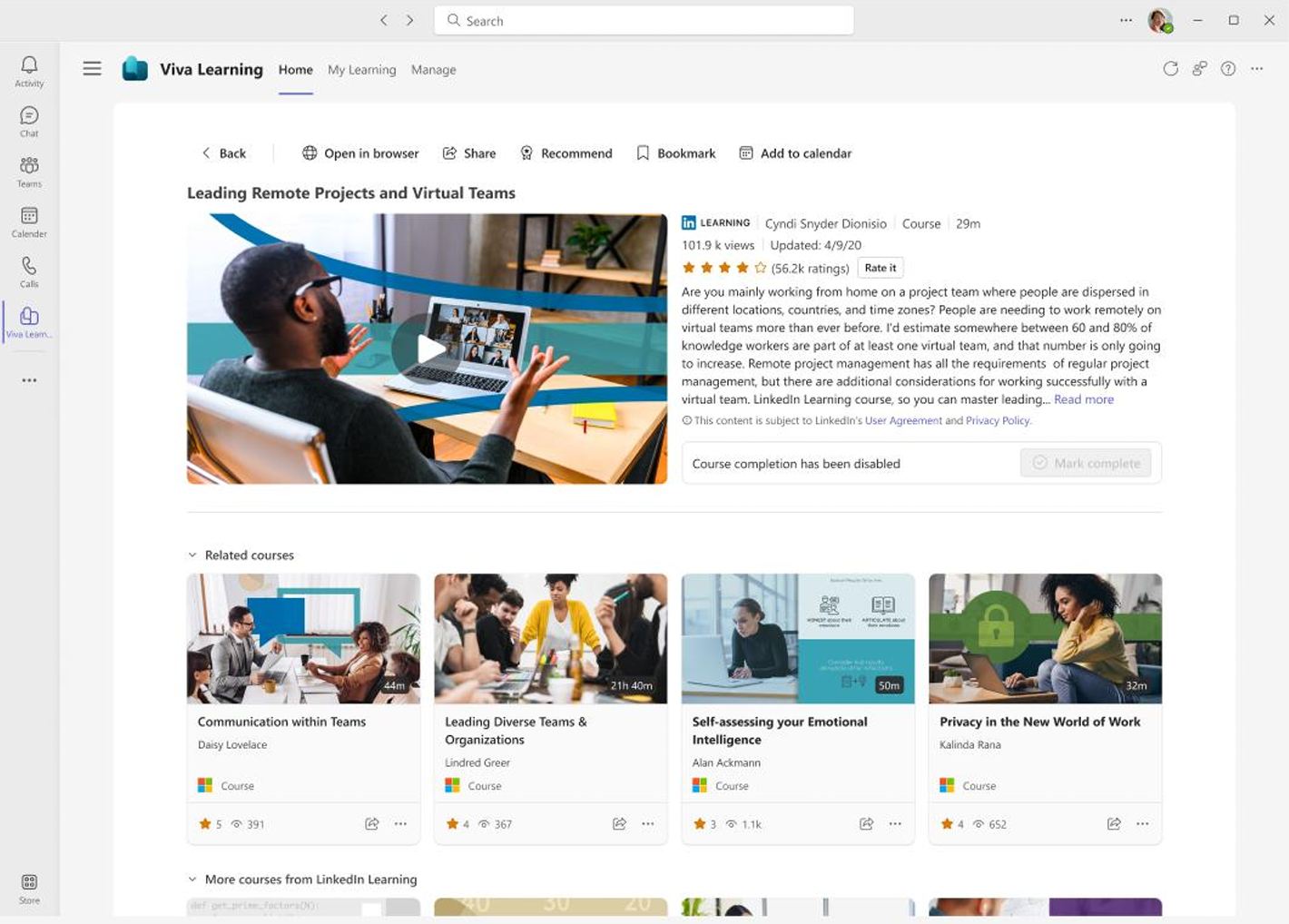
Microsoft Viva Learning is built around this concept. It provides a centralized learning experience within Microsoft Teams, allowing employees to discover, share and consume learning content alongside their normal workplace tools. (Microsoft Learn)
The platform can also connect learning sources and learning management systems, depending on the organization’s configuration. (Microsoft)

Why this matters
Consider an employee preparing for a presentation.
Instead of:
Work → stop → open LMS → search → complete course → return to work
the experience becomes:
Work → encounter problem → access relevant learning → apply it → continue working
That sounds like a small difference, but it can dramatically change whether learning is actually used.
Viva Learning also supports sharing learning content through Teams conversations and channels, which brings social learning directly into workplace communication. (Microsoft Support)
Honest assessment
This approach works particularly well in organizations already invested in Microsoft 365.
Its biggest advantage is convenience and integration.
Its weakness is that organizations with complex LMS requirements may still need additional systems and integrations rather than treating Viva Learning as the entire learning infrastructure.
4. AI-Powered Role-Play and Simulation
Some skills cannot be learned effectively by watching videos.
Negotiation is one example.
Leadership is another.
Customer-service conversations, sales objections, interviews, conflict resolution and performance reviews all benefit from practice.
AI-powered role-play is making that practice considerably easier to scale.
LinkedIn Learning now promotes AI-powered coaching and immersive role-play experiences designed to let learners practice workplace conversations. (LinkedIn Business Solutions)
Imagine a new manager practicing this conversation:
“Your performance has improved, but several deadlines were missed this quarter.”
Instead of practicing with a colleague who already knows the scenario, the employee could interact with an AI character that responds differently depending on what they say.
The employee might try:
Approach A: overly aggressive
Approach B: vague and indirect
Approach C: specific, empathetic and accountable
The system can then provide feedback.
Why this is powerful
It creates a safe environment for failure.
Employees can make mistakes privately before they encounter the real situation.
That’s especially valuable for soft skills because traditional e-learning often explains communication without allowing people to actually practice it.
5. Microlearning and Just-in-Time Training
Microlearning is not simply “short videos.”
Good microlearning answers a very specific question or solves a very specific problem.
For example:
Bad approach
“Complete this 90-minute course about cybersecurity.”
Better approach
“Three signs that an email may be a phishing attempt.”
Or:
“Before approving a purchase order, check these four fields.”
Or:
“How to give constructive feedback in three steps.”
LinkedIn Learning’s current platform includes short-form formats such as Nano Tips alongside longer courses, while also supporting audio, text and hands-on learning formats. (LinkedIn)
The important point is context.
A two-minute lesson is valuable when the employee needs two minutes of information.
Shorter isn’t automatically better.
If the subject requires deep understanding, reducing it to a collection of tiny videos can actually make training worse.
6. Virtual Reality and Immersive Training
Virtual reality is another major innovation, particularly for training where mistakes can be expensive or dangerous.
Examples include:
- Manufacturing
- Aviation
- Healthcare
- Emergency response
- Construction
- Equipment operation
- Industrial safety
Instead of explaining a dangerous situation through slides, organizations can create a simulated environment where employees practice responding to it.
The advantage is not simply that VR looks impressive.
The real benefit is experience without real-world consequences.
A factory worker could practice responding to an equipment failure.
A medical professional could practice a procedure.
A new employee could explore a facility before physically working there.
The problem with VR
VR isn’t automatically appropriate.
Headsets, software, content development, device management and employee acceptance all introduce costs.
For a simple compliance topic, VR can be unnecessary.
For a high-risk operational procedure, however, immersive simulation can be much more compelling.
7. Skills-Based Training and Skills Intelligence
Another major change is the move away from thinking purely in terms of “courses.”
A company doesn’t really need employees to complete 50 courses.
It needs employees to develop specific capabilities.
This is why skills intelligence is becoming increasingly important.
LinkedIn Learning’s current enterprise tools include skills insights designed to help organizations understand existing capabilities, identify gaps and connect skills with learning content. (LinkedIn)
A skills-based training model might look like this:
| Business Need | Required Skill | Current Gap | Learning Response |
|---|---|---|---|
| Expand into AI products | AI literacy | High | AI fundamentals |
| Improve sales conversion | Consultative selling | Medium | Sales simulations |
| Develop managers | Coaching | High | Role-play + mentoring |
| Improve cybersecurity | Threat awareness | Medium | Microlearning |
| Prepare future leaders | Strategic thinking | High | Projects + coaching |
This is much more useful than saying:
“We delivered 12 training courses this quarter.”
The better question is:
“Which business-critical skills improved?”
8. Social and Collaborative Learning
People don’t learn exclusively from instructors.
They learn from colleagues.
They learn by asking questions.
They learn by watching experienced employees solve problems.
They learn through communities.
That is why modern corporate learning platforms increasingly incorporate social learning.
Viva Learning, for example, allows employees to share learning content through Teams conversations, group chats and channels. (Microsoft Support)
This creates an interesting possibility.
Imagine a sales team with a learning channel where employees share:
- Successful sales calls
- Objection-handling examples
- Customer questions
- Useful resources
- Mistakes and lessons learned
The organization’s knowledge becomes a living learning system rather than a collection of static courses.
This can be particularly valuable for onboarding.
Instead of asking a new employee to consume 20 hours of training, the organization can combine formal training with access to the people who already know how the job works.
9. Learning Analytics and Training ROI
Historically, many training departments measured:
- Enrollment
- Attendance
- Completion
- Quiz scores
These numbers are easy to collect.
But they don’t necessarily prove business impact.
Modern learning analytics are moving toward questions such as:
- Which skills are improving?
- Which courses are actually being used?
- Where are employees struggling?
- Which departments have the largest skill gaps?
- Are employees applying what they learned?
- Which learning activities correlate with better performance?
- Where should the company invest next?
Docebo, for example, provides learning dashboards and analytics designed to help organizations understand participation and learning activity. (Docebo)
LinkedIn Learning similarly provides skills-related insights and reporting capabilities around learning activity and skill development. (LinkedIn)
A better ROI model
Instead of:
Training completed = success
consider:
Training → behavior change → performance improvement → business result
For a sales organization, that might mean:
Training → improved discovery calls → higher qualified opportunities → increased revenue.
For customer support:
Training → better troubleshooting → shorter resolution time → higher customer satisfaction.
That is a much stronger business case for corporate learning.
Corporate Training Platform Comparison
There isn’t one universally correct corporate training platform. The right choice depends heavily on the company’s existing technology, workforce, content requirements and learning strategy.
| Platform | Notable Strength | AI / Personalization | Best Fit | Important Consideration |
|---|---|---|---|---|
| Microsoft Viva Learning | Learning inside Microsoft ecosystem | Increasingly strong | Microsoft 365 organizations | Full learning architecture may require integrations |
| LinkedIn Learning | Large expert-led content library | Strong | Skills development at scale | Organizations needing highly proprietary training may need additional systems |
| Docebo | Enterprise LMS + automation | Strong | Organizations wanting extensive LMS capabilities | More substantial implementation than a lightweight learning tool |
| Traditional LMS | Structured administration | Varies | Compliance and formal programs | Can become disconnected from everyday work |
| VR Training | Immersive practice | Depends on solution | High-risk/physical environments | Hardware and content costs |


Microsoft Viva Learning: practical verdict
Viva Learning makes the most sense when the organization already lives inside Microsoft Teams and Microsoft 365.
Its major strength is reducing the distance between work and learning. Microsoft also supports connections with external learning providers and LMS platforms. (Microsoft)
It is less compelling to think of it as a standalone replacement for every enterprise learning requirement.
LinkedIn Learning: practical verdict
LinkedIn Learning is particularly interesting for organizations focused on broad professional development and skills growth.
Its current offering includes thousands of courses, learning paths, hands-on practice, AI coaching, role-play and skills-oriented functionality. (LinkedIn)
Its biggest strength is breadth.
Its challenge is that generic expert content cannot replace company-specific knowledge. A bank, engineering company or healthcare organization will still need proprietary training for internal systems, policies and procedures.
Docebo: practical verdict
Docebo is positioned more deeply as an enterprise learning platform, combining LMS functionality, automation, analytics and AI capabilities. (Docebo)
That makes it interesting for organizations that want more control over their learning infrastructure.
The trade-off is that sophisticated platforms generally require more planning, administration and implementation than simply giving employees access to an online course library.
What Companies Should Not Automate
There is a temptation to treat AI as the answer to everything.
That would be a mistake.
Some parts of corporate learning require human involvement.
Mentoring
An AI system can simulate a conversation, but an experienced executive can provide context based on years of organizational experience.
Leadership development
Leadership is not simply a knowledge problem. It involves judgment, relationships, culture and accountability.
Sensitive conversations
Performance problems, employee conflicts and organizational issues can require human judgment and empathy.
Organizational culture
AI can distribute information about company culture.
It cannot create genuine trust between employees.
The most effective future model is therefore unlikely to be:
Human vs. AI
It is more likely to be:
Human expertise + AI assistance + workplace practice + continuous measurement
Future Trends in Corporate Training
The next stage of corporate training is likely to be less about “taking courses” and more about building capabilities continuously.
Several developments deserve attention.
AI Tutors Will Become More Contextual
Instead of generic chatbots, learning assistants will increasingly use role, skill, task and organizational information to make recommendations.
Microsoft’s current Learning Agent direction already points toward role-specific learning, skill assessments and task-based learning. (Microsoft Support)
Learning Will Become More Embedded
Training will increasingly appear where work happens:
- Teams
- CRM systems
- Productivity software
- Knowledge bases
- Internal communication tools
- Mobile devices
The employee may not even think of the activity as “training.”
Skill Graphs Will Become More Important
Companies will increasingly map:
Roles → Tasks → Skills → Gaps → Learning → Performance
This creates a much more strategic approach to workforce development.
AI Role-Play Will Expand
Customer service, management, sales and communication are natural areas for simulated practice.
The technology will become more useful as scenarios become more specific to the organization’s actual environment.
Internal Knowledge Will Become Training Content
Companies have enormous amounts of useful knowledge hidden inside:
- Documents
- Recorded meetings
- Wikis
- Support tickets
- Project retrospectives
- Presentations
- Internal discussions
AI can potentially transform this information into searchable and interactive learning resources—provided governance, privacy and accuracy are handled properly.
FAQs
What is the biggest innovation in corporate training?
There isn’t a single innovation responsible for the transformation. The major shift is the combination of AI, personalization, skills intelligence, workplace-integrated learning, simulation and analytics.
How is AI changing corporate training?
AI can personalize learning, answer questions, create practice exercises, recommend content, identify skills gaps and simulate workplace conversations. Human review remains important, particularly for specialized or sensitive training.
Is microlearning better than traditional training?
Not necessarily. Microlearning is excellent for specific knowledge and just-in-time support. Complex subjects may still require longer courses, projects, coaching or instructor-led learning.
Is VR worth the investment?
It depends on the training problem. VR can be valuable when employees need to practice physical or high-risk situations. For simple information-based training, traditional digital learning may be more appropriate.
What should companies measure?
Companies should look beyond completion rates. Useful measurements can include skill development, assessment results, behavior change, productivity, quality, sales performance, customer satisfaction and other business outcomes relevant to the training objective.
Will AI replace corporate trainers?
AI is more likely to change the trainer’s role than eliminate it. Trainers can increasingly focus on instructional strategy, coaching, facilitation, scenario design and organizational development while AI handles some personalization, content support and administrative work.
Conclusion
The most interesting innovation in corporate training isn’t a headset, chatbot or learning platform.
It is the gradual disappearance of the boundary between working and learning.
Employees shouldn’t have to wait for an annual training day to develop an important skill. They should be able to learn when a problem appears, practice before an important conversation, receive useful feedback after making a mistake, and discover the next skill they need as their role changes.
Technology makes this possible, but technology alone doesn’t make training effective.
A company can buy an expensive LMS and still have a poor learning culture. It can generate thousands of AI lessons and still fail to improve employee performance. It can create impressive VR simulations that employees never use.
The strongest corporate learning strategies start with the business problem and work backward.
What do employees need to do better?
Which skills are missing?
What type of practice will actually change behavior?
How can learning become part of normal work?
And how will we know that it worked?
Those questions matter more than which technology happens to be fashionable this year.
The future of corporate training is therefore not simply digital training. It is continuous, contextual, measurable and increasingly personalized development—supported by technology but grounded in human judgment and real work.
Author Bio
Muhammad Ahsan is an independent researcher and digital professional interested in technology, workforce development, digital transformation and the practical impact of emerging tools on modern organizations. His work focuses on translating complex technology trends into useful, understandable insights for professionals and businesses. He takes a research-oriented approach to evaluating workplace technologies, with particular interest in how artificial intelligence, automation and digital learning are changing the way people acquire and apply skills.
Verified resources and screenshots used for this article
- Microsoft Viva Learning — official product page — product features, learning-in-the-flow-of-work capabilities and current pricing information. (Microsoft)
- Microsoft Learn — Viva Learning overview — official documentation covering learning sources, Teams integration and personalization. (Microsoft Learn)
- LinkedIn Learning — official learning platform — current course library, learning formats and hands-on learning information. (LinkedIn)
- LinkedIn Learning for Business — current enterprise features including AI coaching, skills intelligence and career development. (LinkedIn Business Solutions)
- Docebo Learning Platform — enterprise LMS, analytics, automation and generative-AI capabilities. (Docebo)
- Docebo AI Assistant — AI Tutor, semantic search and conversational learning analytics. (Docebo)
Note on screenshots: the visuals above are official/product documentation screenshots rather than artificially recreated interface images, so they can be used as visual references without pretending they are independent product reviews.